
This FEELed Note is a contribution from Erin Delfs who took care of the FEELed Lab (alongside Sierra Lammi) this summer while most FEELed members were away. Erin (she/her) is a graduate student in the Community Engagement, Social Change, & Equity program at UBC Okanagan. Erin’s research interests include post-neoliberal health equity, intersectional climate justice, and youth-led organizing and activism.
A conversation between Erin Delfs, Sierra Lammi, & Woodhaven on Syilx Territory
*laughter*
Erin: When Astrida invited us to do blog posts for the FEELed Lab to reflect on the summer we spent coming to work here at Woodhaven, what stood out most for me was the relationship I have begun to build with this place -Woodhaven on Syilx Territory – and the way that I got to know you [Sierra] better when we would come out here to work and take lunch breaks. So I thought a good way to anchor my blog post to those relationships would be to kind of reflect with you on our time here together in conversation, record the conversation, and type it up. Although we aren’t properly employing Visiting methodology here, this kind of conversational knowledge mobilization was inspired by our Indigenous Research Methods class with Shawn Wilson and our lovely classmates, wherein which we engaged with Visiting as an Indigenist methodology (Gaudet, 2018; Tuck et al., 2023; Wilson et al., 2019).
Sierra: Aww. The things that stood out to me as well were quite similar, including the relationship that we developed with this place, and in different ways than we would have during the year, right? It was really special to be here in the summer when everything was a little bit quieter and kind of a different vibe. Getting to know you also stood out, like having really long chats by the river. Being together while not working on our theses was also really nice, because it’s so hard to stop thinking about your thesis sometimes. So even though we come to this place to work, it becomes about so much more than the thesis. It becomes much more holistic with the relationships that you build, you know, here with the Land and with the place itself, but then also with the people that you come here with.
Erin: I’ve been thinking a lot lately about building relationships to Land, which is something we learned about through our class with Shawn, and through our classmates and our friends. But I’ve also realized that maybe this summer I’ve been more so learning/building a relationship to how to build a relationship with the Land, if that makes sense. Through our climate activism and stuff lately, for instance, where we’re thinking and figuring out how to go about building intentional ties to Syilx Territory as (many of us) settlers, and how to go about building reciprocal relationships with Syilx People who govern the Land, I think about how building a relationship to this Land is inseparable from building a relationship to the Syilx People who steward it.
Sierra: I think that’s a good way to approach it, right, as you’re learning how to build a relationship with something and doing it in an intentional way. And there’s so many things that go into that. I feel like I’ve had similar experiences of learning how to be in relationship with places. And for me, a lot of times, just like with Woodhaven specifically, when I would come out to write or something outside it felt, I don’t know, very comforting. I felt very cared for –
Erin: Held.
Sierra: Yeah, held. It was just very comforting in so many ways to feel like this place genuinely like cares about people as well. And so then that’s like the reciprocity of it. The Land cares for you, so you of course also care for the Land and the people who steward the Land and part of that caring comes from acknowledging and learning and unlearning yourself to find ways to build an authentic relationship.
Erin: That’s a good point. I was literally just re-reading “Emerging from the Whiteout” by Bill Cohen and Natalie A. Chambers – we read it for our a class last term, I think.
Sierra: Oh yeah.
Erin: And I was reading about how the Land knows how to take care of people but people don’t always know how to take care of the Land as well. Especially you and I as settlers, we don’t really know how to take care of this Land that isn’t ours. So it’s interesting to explore that.
But yeah, I feel like relationship has been a big theme for me over the summer, including my relationship to my thesis. That relationship really ebbed and flowed, and not to be corny but I’m now thinking about where we’re sitting right now, by the river, which has also ebbed and flowed all summer. Early June, we were able to fully lie down in the water.
Sierra: And you wouldn’t be able to do that now because the water is low, and I think that’s kind of a cool way to think about how things are always changing, while also being consistent. I felt like this place was always here for me in different ways, and how we can be there for places as they change too, and for the people who are wrapped up in these places. It’s like, to be there for a place you have to be there for the people and take care of the Land, and show up for #Landback movements, and you know, make sure these things are done together and not separately.
Erin: Imagine this becoming a place-based discussion.
*laughter*
Sierra: I know, right? Wild.
Erin: We’re sitting here at the river where we would have lunch all summer, on the same rock –
Sierra: On the very rock!
Erin: -with a branch in my face. But I wouldn’t have it any other way. I love a tree touch. [Laughter]. And I know when we stand up we’ll have sap stains on our jeans. Yep. A little piece of Woodhaven that goes with me everywhere.
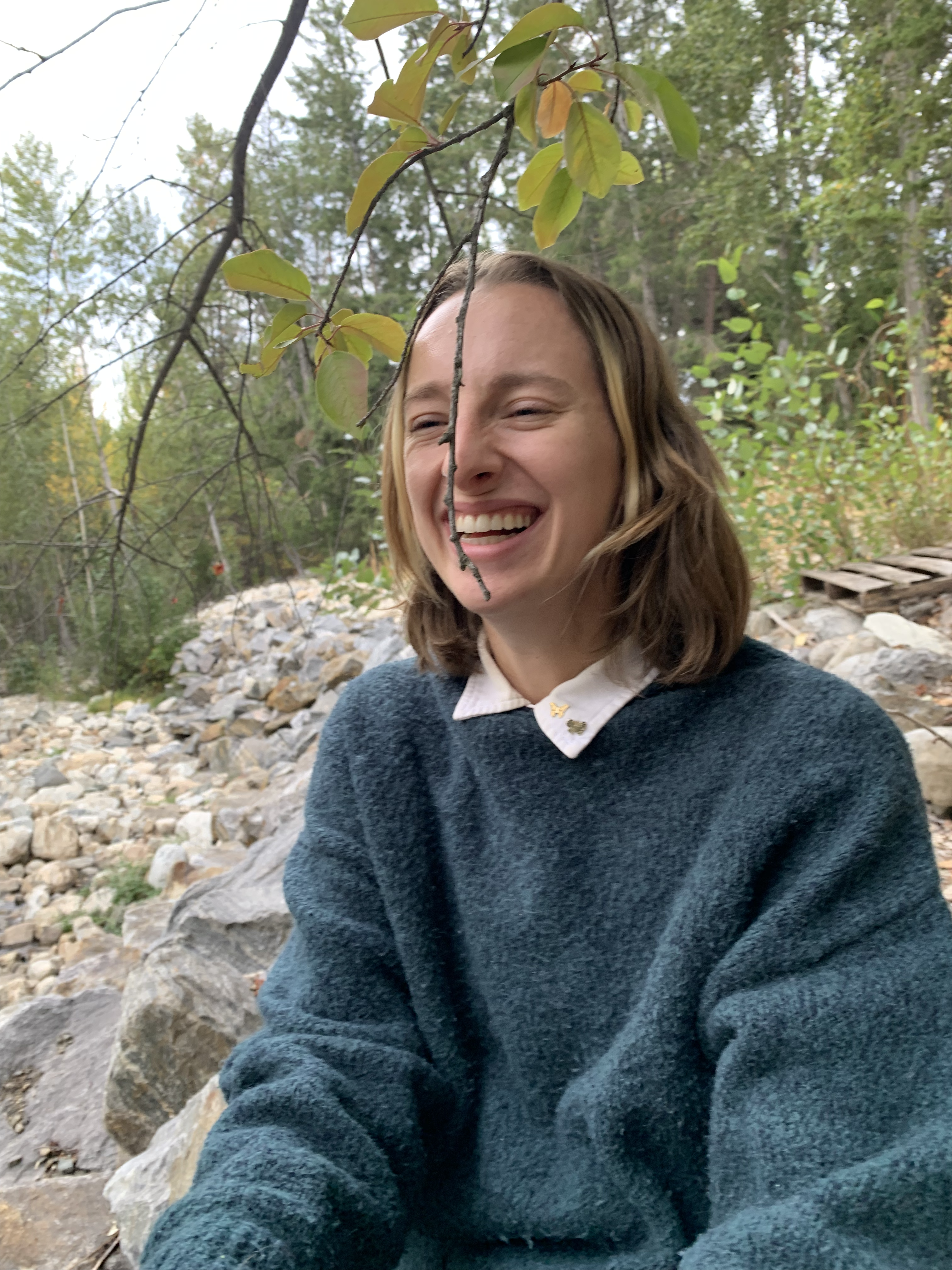
Sierra: I was thinking about that too, especially on this rock where we’re sitting, I feel like there were a lot of times where we’d come out for lunch and I’d think in my mind “oh we’ll eat for like a half an hour and then go back to work” but then we’d end up staying for like an hour and a half. I intended to come here to be like “productive” and do good writing and stuff but I think it’s so productive to have meaningful relationships, so I think one of the productive things for me when we came here was that we got to know each other a lot better. And then also, it’s productive to not think about your thesis sometimes, right? And to have a place that kind of exists outside of that paradigm that we create for ourselves.
Erin: Yeah, it’s weird to fit anti-capitalist notions of productivity into a capitalist thing like a master’s thesis. As a by-product of spending so much time here, I started looking at my thesis with more and more attention to Land and place and Indigenous sovereignty. So reading through municipal policies about community well-being, I found myself always attending to how colonial they were, how colonial they are as colonial policies from a colonial government. I think that the more I build relationships to the Land and think about my positionality in certain places, the harder it is to not think about that in other arenas of my life. And I think that’s good, I think that’s extremely productive if we think of “productive” defined as holding potential for transforming things towards #Landback, and transforming my view of the world away from the Eurocentric, colonial shaping it’s received up to this point. Being here has definitely prompted unlearning.
Sierra: Well then it kind of goes back to what you said before about learning how to have relationships, right? You’re always learning how to like foster and create those relationships and connections between these ideas that you’re having in places and ideas that you take into the world. Your thesis is a part of that web, but I think the more important piece involves the ideas that you take with you outside of it.
Erin: Yeah, true. We learn and move and travel so far through relationships. The reason we are even here at Woodhaven right now is because of our friendships to Dani, and her welcoming us to use this space over the summer.
Sierra: One, that was just so generous and kind of Dani and Astrida to welcome us, and two, I genuinely felt very welcomed here. It felt like coming home in different senses, right? To a place that was familiar. I would think of Dani all the time when we were here and be like, “Oh, I’m excited to see her.” I would think of a funny memory that we had with her or like a laugh that we had about something. And then, and with Astrida too, you know, just like different conversations that we had had. So that was another thing that I experienced over the whole summer, were the many good memories of people we have interacted with here.
Erin: Like spending with Tom and Yazdan.
Sierra: And people really far away too – Suzi and their sister Ruti, and Selina, Lola’s sister, were all here at one point and now they’re, you know, I didn’t know them for super long and now everyone’s kind of across the pond in Europe. But it’s still nice, it feels like a little reminder of the time spent together.
Erin: Yeah. And it’s interesting, I guess, to simultaneously feel really welcome here-
Sierra: Yeah.
Eri: -but then also to be uninvited as well. And I don’t know how to adequately unpack those concepts in this conversation, but I think it’s important to know that they exist at the same time – to be uninvited settlers on Syilx Territory while also having such a strong emotional connection to Woodhaven. But perhaps that’s part of it. There are a lot of things that exist simultaneously, and I think it’s maybe part of the unlearning and the work we must do as settlers to be able to hold those things together, grapple with their nuance, and unpack them for ourselves. One small piece of nuance involves how while Dani and Astrida welcomed us here directly, Dani has also – through our conversations and through her thoughtful reflections I’ve borne witness to – welcomed me into thinking more deeply about my place on this Land as a settler.
Sierra: Yeah, for sure.
Erin: We share space, but we also share responsibility and we share information with each other about how to be more responsible, as settlers on this Land for instance.
Sierra: There are a lot of ways to like to do that, right? I think I know what you’re getting at.
Erin: Now I’m suddenly thinking about how we saw the bear here that one time.
Sierra: No I was thinking about that too, because then part of the relationship that you’re building like with the Land involves the critters in the forest. When things are busy and bustling the animals aren’t coming around as much. It was an honor and a privilege to be able to be here when things were a little bit quieter and kind of share space. And of course, we’re always sharing space with animals-
Erin: and rocks.
Sierra: What?
Erin: I said “rocks”.
Sierra: Rocks. Rivers. Yeah.
Erin: Yeah, it was cool to see the bear.
Sierra: It was really cool to see the bear.
Erin: I remember you being like, “Holy shit, it’s a bear!”
Sierra: I know! When we first did our orientation and Astrida had talked to us about doing the blogs for the FEELed Lab, that was an example she gave. She was like, “Oh, and then maybe one day you’ll see a bear and write about that.”
Erin: And we did indeed. And you shared that with her in an email recently.
Sierra: I did. I was so excited, because I didn’t actually think that we would, I don’t know why. I just assumed we might not be at the right place at the right time, and it was just very unexpected, I think.
Erin: It was.
Sierra: But then there were a lot of things this summer that were very unexpected. Some of my most productive times at Woodhaven, I think, were times that I didn’t do any writing for my thesis at all.
Erin: Your Idea Walks.
Sierra: Yeah, my Idea Walks. And then again, just being present in a place. Because that was so hard for me, to slow down and do that during the year and during other times. So lots of little unexpected things like that kind of came up over time.
Erin: I can’t help but think – classic me – about how reducing green spaces, and reducing access to “natural areas” is a capitalist strategy to keep us anchored to our jobs and to keep us from reflecting on a greater purpose outside of producing capital, you know? So like here at Woodhaven we sit with the river and with the trees and with the sky and feel somehow far away from the concrete jungle of Kelowna, and I feel like it makes sense in that regard why we’re having different experiences of “productivity” here.
Sierra: It does make sense. It’s like this little pocket kind of that exists like inside/outside of the university, and in this pocket there’s more space to be authentic and intentional with your relationships to so many things. Sometimes when I work at my office or something I feel like I’m in like office mode, facilitating whichever people come in and trying to meet expectations to behave a certain way that’s allowed and accepted. But when we would come to work at the FEELed Lab, there were days when I felt really not good about something, or about my thesis or whatever, but I didn’t feel like I had to mask those feelings, you know?
Erin: And then there are different priorities when you’re in an office or whatever. My office space is literally a windowless cave.
Sierra: Yeah, exactly.
Erin: At the office, my concerns are meeting deadlines and writing error-free and trying to proceed through my master’s degree so that I can get the recognition to be able to operate in this society at like, an above minimum-wage level. But then I come out here and I remember – I see the river perhaps lower than it would like to be, and I remember that producing capital is the least important thing. #Landback, supporting Land Defenders, being responsible to the Land, and sharing that responsibility…I literally cannot think of a more important thing.
Sierra: Yeah, it’s true. Sometimes it’s nice to get a different perspective, right? One of the things that I love about nature just in general, like being out on the Land and being outside is that I often like feel small there, because I feel like I have a bigger perspective of the many things that are bigger than me and like my thesis.
Erin: Bigger than your problems.
Sierra: Yeah, exactly. And not to say that, you know – people have problems and these problems should be like addressed and everything, and I don’t want to take away from that at all.
Erin: Yeah.
Sierra: But I feel like it’s so easy to get wrapped up in our own things that ultimately are not going to affect us. I’m excited about my thesis and everything and you know, whatever, but in the long run, like that’s two years that I’m working on this.
Erin: Yeah. But that’s by design – that preoccupation with production, and preoccupation with the problems you face through the production process.
Sierra: Yeah, yeah. When I have those feelings in my office, you know, I don’t know really know what to do with them. I don’t really have a place to put them. But when I have those feelings here at Woodhaven, I can go for a walk or I can sit outside and listen to my book and listen to everything else. I can just be and be reminded that there are so many bigger things out there, bigger than some of the things that we get caught up in the day-to-day. I know I stress myself about it, about some of those little things, like way more than I need to.
Erin: Yeah. And I guess the bigger things out there are still our problems.
Sierra: Yeah.
Erin: But a lot of people don’t see themselves as tied to those problems. So it requires a process of understanding ourselves as interconnected with those problems.
Sierra: Yeah totally.
Erin: And then shifting our energy towards a question of – how do we act?
Sierra: Yeah that’s a good point. Putting yourself in relation to the problem and recognizing everything that comes with that right? Or, I don’t know…
Erin: Being able to see things outside of yourself as an individual?
Sierra: Yeah yeah yeah. Or I don’t know. Like the idea of placing yourself within the issues of the world because sometimes a lot of these things seem so big and complicated and it’s hard to put yourself in relation to them.
Erin: Yeah it’s weird, and I guess for me it’s less about putting myself there, but realizing I am there.
Sierra: Yeah true.
Erin: When I try to place myself in the context of these “big issues,” they seem so big, but when I realize I’m already there and part of them, I understand that I’m part of these issues no matter what. The size of them doesn’t change whether I’m implicated or not.
Sierra: No, it’s true. Because to imply that you’re putting yourself there implies that –
Erin: It’s a choice?
Sierra: That it’s a choice, yeah, and that people are not there already.
Erin: Yeah.
Sierra: Because people are wrapped up in these “big issues” already, and are actively grappling and resisting them. So it’s important to find where you are. And not in like, a doom and gloom kind of way. I think that it’s more hopeful a lot of times to recognize your position because you realize like, okay, we’re all here, but we’re not alone here.
Erin: Right. We’re not alone.

References
Gaudet, J. C. (2018). Keeoukaywin: The Visiting Way – Fostering an Indigenous Research Methodology. Aboriginal Policy Studies, 7(2), Article 2. https://doi.org/10.5663/aps.v7i2.29336
Tuck, E., Stepetin, H., Beaulne-Stuebing, R., & Billows, J. (2023). Visiting as an Indigenous feminist practice. Gender and Education, 35(2), 144–155. https://doi.org/10.1080/09540253.2022.2078796
Wilson, S., & Breen, A. V. (2019). Research and Reconciliation: Unsettling Ways of Knowing Through Indigenous Relationships. Canadian Scholars. http://ebookcentral.proquest.com/lib/ubc/detail.action?docID=6282054
 The FEELed lab