
This FEELed Note is a contribution from Daisy Pullman, a team member on the Cultivating Environmental Attention project. In this note, Daisy reflects on her experiencing presenting on FEELed Lab research at the 4S conference in Honolulu.
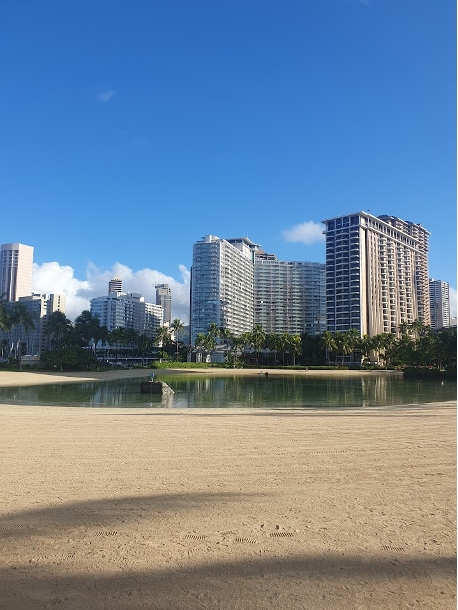
Walking around Honolulu, especially the hyper-touristic neighbourhood of Waikiki is to be slapped in the face with dissonances.
Tourists swim and play on the beach beside the Hilton, a US Navy ship looms onto the horizon.
Unhoused people fish at the beach, a mega yacht moors up at an adjacent marina.
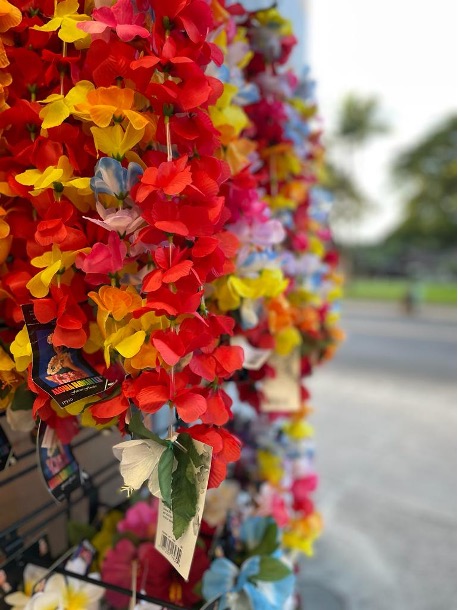
Dozens of shops selling plastic leis and hula girls for my dashboard. But not a grocery store.
Military fatigues mixing with Hawai’ian shirts in the crowded streets.
Starbucks and IHOP and the Ramada and McDonalds and Walmart and the Marriott.
In early November three of us from the FEELed lab, Natalie Forssman, Astrida Niemanis and myself, travelled to Honolulu, Hawai’i, to attend the 4S conference. This conference is the annual gathering of the Society for the Social Study of Science (4S), representing researchers engaging in interdisciplinary science and technology studies (STS).
We presented as a part of the panel STS: Pedagogies of Sea, Sky, and Land. Our paper was structured around three “productive tensions”, or to borrow a perfect phrase from our co-panellists Hidekazu Kanemitsu and Miki Namba’s paper, “evocative dissonances”, that emerged in the process of our work developing an undergraduate class in place-based methods that centres accessibility and inclusion.
In a place like Honolulu, the decision to focus our paper on tension and dissonance felt fitting. Even before arriving, I felt a certain discomfort with the idea of visiting Hawai’i. For years locals have repeatedly and explicitly called for tourists to stay away due to the devastating impacts of the tourism industry on communities and environments. The apocalyptic Maui fires this summer brought this call into sharper focus.
By going to Honolulu, staying in a chain hotel, drinking the water, swimming in the sea, I am part of this problem. I am straining the resources and supporting the colonial tourism-industrial complex that dominates Hawai’i. Is it justified because I am there for work? For a conference?
In a clear acknowledgement of the tensions of hosting in Hawai’i, the theme of this year’s 4S conference was Sea, Sky, and Land: Engaging in Solidarity in Endangered Ecologies. The keynotes and panels confronted and engaged with the tensions of Hawai’ian colonial history, all presenters were invited to participate in a Paraconference that sited their research in the context of Hawai’i, and the organisers collaborated with local charities to offer volunteer opportunities for conference attendees. Despite these commendable efforts to confront the tensions, the dissonance of thousands of people flying to the colonised, militarised, touristic, ecologically fragile city of Honolulu, in order to discuss endangered ecologies (often in abstract terms) is inescapable.
Aikau, Hokulani K., and Vernadette Vicuña Gonzalez. Detours: A Decolonial Guide to Hawai’i. Duke University Press, 2019.
Hawai’i Doesn’t Want Visitors Right Now, Or Ever. Here’s Why April 2023
Kanemitsu, Hidekazu and Miki Namba. ‘The Potential of Transnational Sustainability
Education: Reflections from Practices’ (presented at the 4S conference, Honolulu, Hawai’i November 10th 2023).
 The FEELed lab