
This FEELed Note is from Grace Henri who is a research affiliate leading project “Nostalgia Forecast”, which investigates the complexity of eco-grief, and more specifically, how we mourn what we have not yet lost.
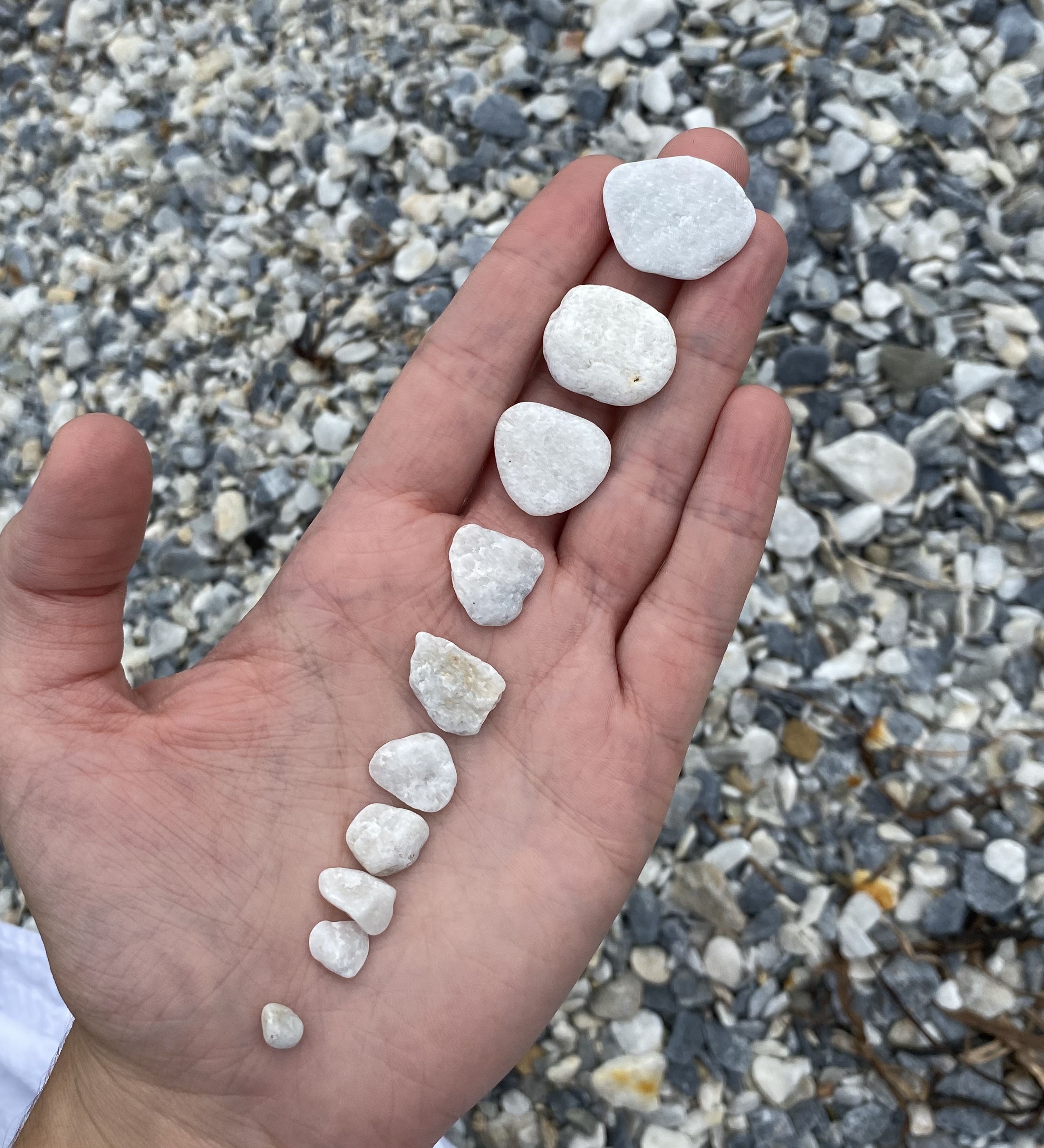
Every day we line up small rocks by the shoreline. Methodically we push them into the smooth sand, spread equally apart and ordered by size. A whole beach arranged neatly and logically.
In today’s world of ongoing and lived climate disaster, it’s increasingly common to feel fearful, distressed, and disconnected from the land on which someone lives on and with. The term eco-grief describes the emotional weight of lived and anticipated environmental losses, including the loss of non-human life, ecosystems, cultural practices, or future expectations. According to data collected from young Canadians, 78% stated that their emotions surrounding climate change negatively impact their daily functioning, while 56% reported feeling explicitly sad or powerless. Despite these challenges, there is a lack of widely agreed-upon strategies to foster resilience and address climate-related distress.
While grieving the loss of loved ones may not appear the same as experiences of climate loss, we can learn a lot about how to provide support and combat hopelessness by borrowing similar structures of care. Grieving rituals vary widely across cultures and traditions, typically serving as a means of honouring the deceased, providing comfort to the bereaved, and facilitating the process of mourning. Rituals are described as embodied actions with a greater abstract, symbolic meaning. Examples of grieving rituals vary widely, but may include community vigils, letter writing to the deceased, drumming ceremony, or storytelling. These practices are often culturally specific and aim to connect the bereaved to what they have lost and to what remains.
Regarding eco-grief, when rituals provide symbolic meaning through intentional actions, we can begin to foster a sense of gratitude, identity, and reconnection within our ecosystem. Environmental rituals may help to ground us in a place and time, holding space to acknowledge lived environmental losses and uncertain futures. Through commemorative ceremony we tend to our own emotional experiences with climate change in community, while also beginning to relearn our positionality within the environment.
Each day that we return to the shore, the tides have swept our rocks out to sea – leaving no trace behind, our work reversed into something dismantled and unorderly. And so, we start again – carefully collecting rocks and leaving them behind, neatly in a row. We must not let our fear turn to blame.
In action, eco-grief rituals provide ways to honour and process feelings of loss related to environmental degradation and climate change and may include practices of eco-writing or gift giving. Starting in 2003, Grandmother Water Walker (or Grandma Josephine), an Anishinabek Nation Elder, began ritual walks around the Great Lakes. Each year, these water walks were joined by Elders, community members, and grievers, holding an Indigenous-led space inspired by protection of sacred water resources. In Victoria, BC, The Dzunuk’wa Society hosts prayer walks for the sacred old growth forests, threatened by logging efforts. These walks allow participants to grieve in community, founded on the importance of preserving our forests. Seen throughout both these examples, engaging environmental activism itself could be considered a ritualistic way to tend to emotional healing by channeling feelings of grief into collective action.

The functionality of ritual practice can be understood as a form of commemoration and preparation – both of which help the bereaved sustain strong bonds with those that have been lost. For example, in grieving the death of a loved one, commemoration serves as a celebration of life. By commemorating our losses, we anchor ourselves to memories, we carve out space for our loved ones to remain in our life – despite their absence. To contrast, ritual practice also serves to prepare ourselves for our new lived reality. To repeat symbolically significant actions allows us to train ourselves away from despair and towards comfort, and familiarity. Through ritual and repetition, we hold our grief in our hands, we inspect it, sit with it, feel its sharp edges, maybe even find something familiar buried within.
In the respect of environmental losses, ritual serves similarly as a resilience strategy with a focus on emotional connection and healing. To commemorate our environment is to acknowledge the life and memories that live on despite environmental losses. To prepare ourselves for the lived realities of environmental losses through ritual practice is to create space to feel our grief in its full, existential capacity.
When the river dries, how do we remember her without holding her water in our hands? When the forest burns, how should we help her lick her wounds? When we feel a growing wind, how can we listen to the message that blows through us? – We return to collect the rocks, neatly by the shore.
By adding symbolic meaning to our actions through grief ritual, we acknowledge our interconnectedness within our environment. This perspective shifts our relationship from one of opposition or separation to one of harmony and integration. It reminds us that we are not isolated individuals but part of a larger whole, deeply intertwined within a land – a land that also grieves the weight of environmental losses.
Environmental grief rituals serve as a powerful antidote to the sense of hopelessness arising through environmental losses. By joining together, separate or in community, we validate these emotions with a structure for healing molded by our own symbolic creations. Furthermore, healing has the capacity to propel us towards action, turning hopelessness into purpose and dedication. Ritual practice is a transformative experience that allows us to reimagine our futures and bind ourselves towards stewardship by processing the emotional weight of what we have lost. Only when we tend to our wounds can our skin grow thicker.
Over time, our hands will transform with the changing tides. The more we return to repeat our work, the more the sand will greet us like an old friend, the more the rocks will fit around the grooves in our hands. I am here. I am alive. So are you. Like a rock tossed in an unrelenting current – when the tide rolls out, together, we will return to the shore.
References
Barnhill, J. (2011). Giving meaning to grief: The role of rituals and stories in coping with sudden family loss.
Cunsolo. A., & Ellis, N. (2018). Ecological grief as a mental health response to climate change-related loss. Nature Climate Change. Vol 8, 275-281. https://doi.org/10.1038/s41558-018-0092-2
The Dzunuk’wa Society. (n.d.). The Dzunuk’wa Society: Events. https://www.dzunukwasociety.com/upcoming-events
Galaway, L., & Field, E. (2023). Climate emotions and anxiety amount young people in Canada: A national survey and call to action. The Journal of Climate Change and Health. Vol 9. https://doi.org/10.1016/j.joclim.2023.100204
Mother Earth Water Walk. (n.d.). Mother Earth Water Walk: About Us. http://www.motherearthwaterwalk.com/?page_id=11
Wojtkowiak, J., Lind, J., & Smid, G. (2021). Therapy for prolonged grief: A scoping review of ritual in evidence-informed grief interventions.
 The FEELed lab