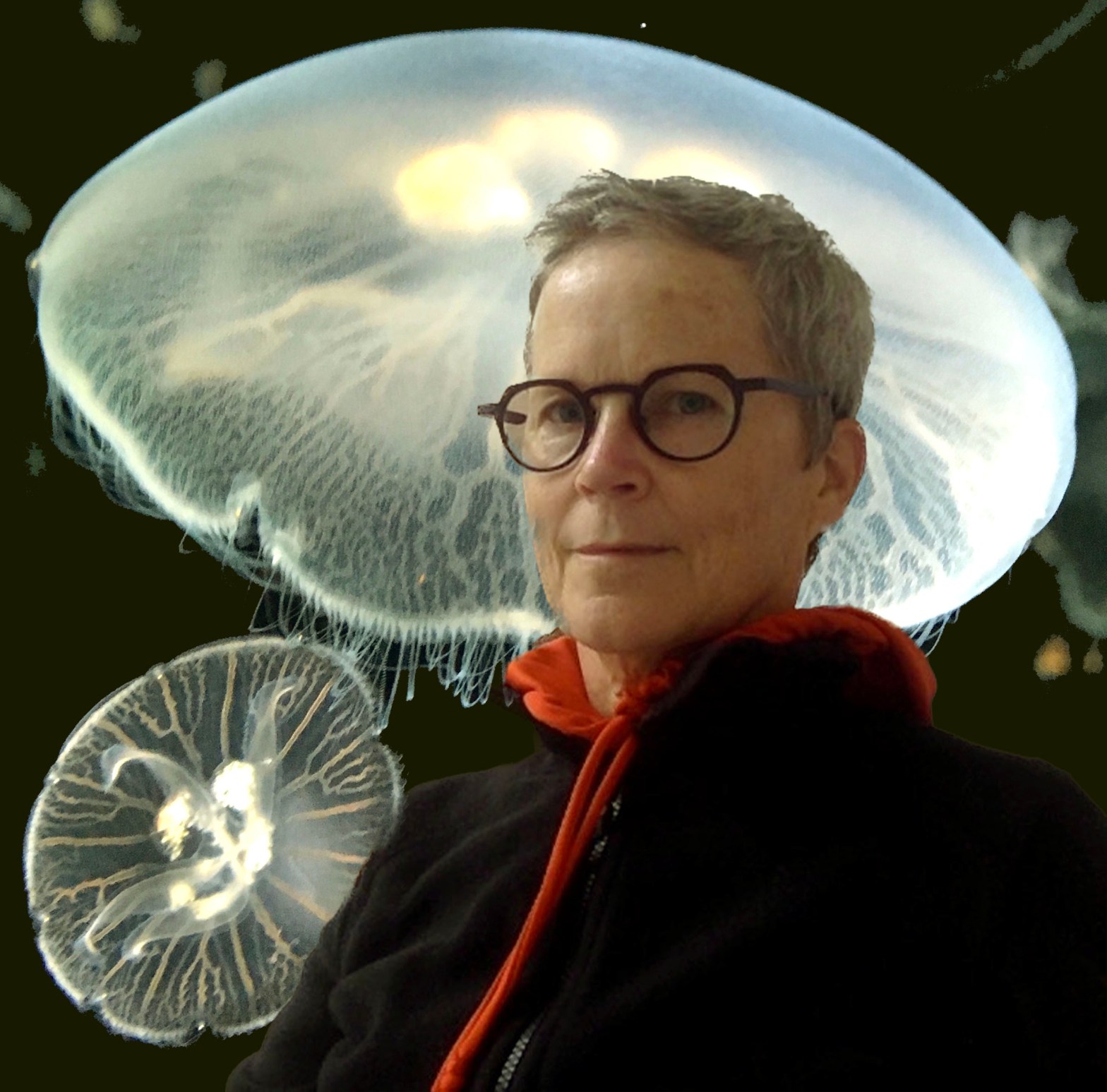
As we welcome new people to the FEELed Lab, we want to make space for longer introductions to project team members and research affiliates joining us this year. This profile is on Sue Reid, who is joining the FEELed Lab as a postdoctoral fellow researching multibeing onotologies with a focus on human-ocean relationships.
1.Can you tell us about your work/research?
I research multibeing ontologies– this is a term I conjured to describe intersecting conditions of relational materiality, phenomenology, sociality, and temporality constituting embodied being. My research draws on feminist, queer and decolonizing theory to explore how intersectional issues, including physical location, influence multibeing experiences. So far, I’ve mostly focused on human-ocean relationships, extractivism, and justice. Other locational contexts (terrestrial, atmospheric, lithic etc.) are also important in their own way and through their oceanic connections.
My research really is transdisciplinary and this sometimes makes it a bit hard to offer a quick soundbite. I draw on experiences and expertise across cultural studies, law, environmental activism, and contemporary art. Close reading of scientific material, field immersions, multibeing visual journaling – walking or swimming are also important. These methods and approaches manifest at different times in theoretical, philosophical, visual, and writerly form, as needed.
2.Why did you want to work with the FEELed Lab?
As a postdoctoral fellow at UBC’s Faculty of Critical and Creative Studies, I’m keen to connect with a diverse range of scholars, artists, activists who think critically about extractivism and imagine ways of doing planetary relations less violently. I feel that the FEELed Lab members and conversations are concerned with these things. What is especially appealing about working with the FEELed Lab is that, as well as being a hub for interdisciplinary knowledge exchange, it explores and advances tactics for decolonizing environmental humanities research.
3.Why are expansive engagements with environmental issues important?
They are unavoidable. We humans and others are multibeing–made by and makers of worlds. Along with other influences that determine how worlds are experienced and made (life-stage, vulnerabilities, privileges, location…), human imaginaries/myths/narratives also figure in how humans experience and interact with the world. The ideology and implementation of settler colonialism and modernism, in particular, landed like endless stone nets over multibeing worlds and in particular Indigenous lands and relations with those lands. They sedimented a normative belligerence against diverse ways, relationships, and communities of being and continue to tie us all to the ensuing catastrophes.
Economically driven, extractive practices continue to collapse familiar biomes and multibeing relations. Gassed-up, blue and green-washed institutional strategies are sold as bulwarks to the warming climate and ecological decline but, at best, they merely bandaid the structural violences of Modernism and its disastrous experiment of extractive capitalism. Better policy and legal frameworks are vital, of course, as are critiques. More than ever though, what is urgently needed are conceptual spaces for imagining and creating alternate praxes of being–ones that engender kinder, and more abundant multibeing worlds and kinships, and which simultaneously foreground and enable longstanding Indigenous praxes that already do this so brilliantly.
So yes, expansive engagements with environmental issues are important. Every scholarly field is impacted by the environment–maintaining a siloed approach is irresponsible. At the same time, every scholarly field performs a narrative. Failing to interrogate narratives and sponsoring institutions, which perpetuate environmental and settler colonial violences, is also irresponsible. Commitments and strategies to dismantle them are urgent.
 The FEELed lab