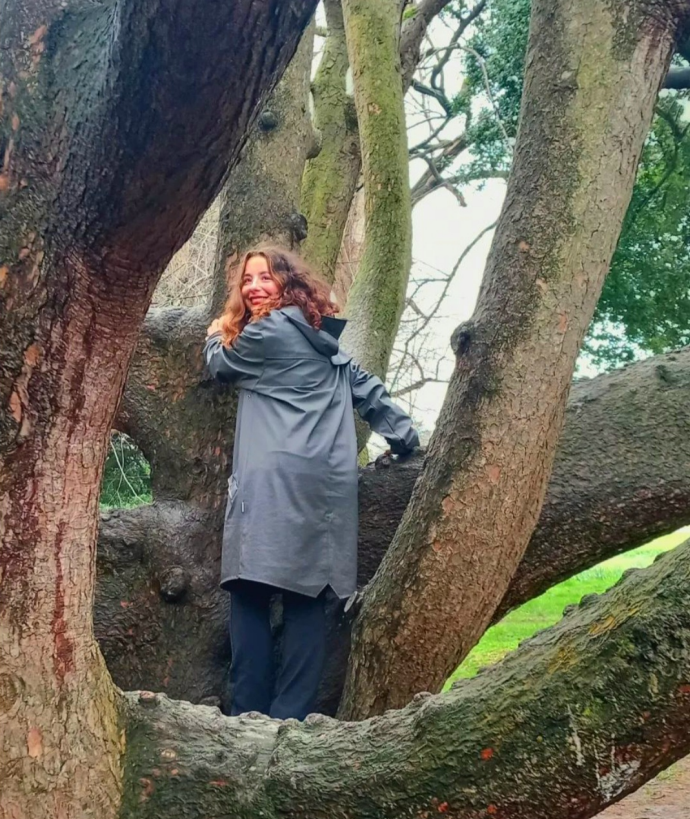
As we welcome new people to the FEELed Lab, we want to make space for longer introductions to project team members and research affiliates joining us this year. This profile is on Manuela Rosso – Brugnach, who is joining the FEELed Lab as a PhD student exploring the confluence of sustainability, linguistics, polyphony, and art, with a particular focus on human-water dynamics within diverse cultural frameworks.
1.Can you tell us about your work/research?
My research as a Ph.D. candidate at UBC Okanagan explores the confluence of sustainability, linguistics, polyphony, and art, with a particular focus on human-water dynamics within diverse cultural frameworks. As someone with a transdisciplinary background and a life shaped by migration across various countries, I approach sustainability and environmental discourse through a lens of movement, elision, and multiplicity. This fluidity invites possibilities for viewing water not just as a resource but as a relational entity that contributes to identity and community resilience. Through multilingual and decolonial methodologies that employ a hydrofeminist and emergent strategy lens, inspired by thinkers such as Dr. Astrida Neimanis, Dr. Cecilia Åsberg, and Dr. Doris Sommer amongst others, I examine how resilience discourse can be enriched by incorporating the voices and narratives of grassroots and Indigenous communities, alongside structured institutional perspectives. My work speaks to an ambition of blending academic and experiential knowledge, allowing me to explore resilience in a way that is both ecologically inclusive, culturally respectful, and one that inflects water’s relational and life-sustaining role across species and communities.
2.Why did you want to work with the FEELed Lab?
Joining the FEELed Lab has been a natural fit for my work, as the lab substantiates the creative, interdisciplinary, and relational approach I value in environmental research. The FEELed Lab’s emphasis on ecological relationships registers vividly with my hydrofeminist perspective on water and resilience, which views water as a relational being deeply connected to cultural, ecological, and emotional dimensions. What really speaks to me is the lab’s commitment to integrating diverse voices and multispecies perspectives in its research, which threads through my goal of de-centering traditional, anthropocentric approaches to sustainability. Working with the FEELed Lab offers a sui generis space to not only explore these ideas but also collaboratively call them in, weaving an interconnected perspective of resilience, unfurling space for it as a polyphonic, multi-voiced ethos.
3.Why are expansive engagements with environmental issues important?
Expansive engagements are essential because they unveil possibilities for a more inclusive, culturally nuanced, and ecologically holistic understanding of resilience and sustainability. Environmental issues are inherently composite and fused within cultural, linguistic, and political dimensions that can’t be addressed through a singular perspective. By bringing in diverse voices—be it through grassroots narratives, Indigenous knowledge, trans- or multilingual frameworks and schemas—we move beyond reductive, policy-driven models toward a relational, hydrofeminist, decolonial, and multispecies approach. This vast engagement imparts a resilience that honors both human and more-than-human communities, gently rethinking colonial, and commodifying narratives to cultivate a more equitable and sustainable future for a shared life.
 The FEELed lab