
This blog post was written by FEELed Lab Research Associate Erin Delfs, as part of our support to syilx-led climate justice.
On September 27, 2024, a group of very cool people – Indigenous people from syilx territory and beyond joined by a group of UBC Okanagan professors and students keen on building understanding and support – gathered for a weekend of listening, learning, navigating, and connecting on and with syilx[1] land. This gathering marked the start of the year-long program Earth Sense.
As articulated on the program website, Earth Sense is “a hybrid training program” primarily intended “for Indigenous Peoples who work in community and dream of using land-based learning to strengthen connections to themselves, each other, and all beings.” A second dimension of Earth Sense involves grappling with the language and meaning of “climate justice” on syilx territory. Various Indigenous collectives and movements like The Red Nation, Indigenous Climate Action, Idle No More, Unist’ot’en Camp, and Bringing the Salmon Home demonstrate how Indigenous sovereignty and climate justice are inextricable processes. However, many people associate the term “climate justice” with settler academic contexts. How relevant, or useful, is the term “climate justice” to syilx people and communities who have engaged in sustainable practices, guided by sustainable worldviews, for thousands of years? (Armstrong, Derickson, Maracle & Younging 1994; Armstrong 2009; Cohen and Chambers 2021).
IndigenEYEZ’s launching of Earth Sense has created a space for trained facilitators and community leaders from IndigenEYEZ and climate justice researchers from the FEELed Lab to collaborate and explore these questions together. IndigenEYEZ is an Indigenous-led organization that has been delivering trainings and programs (e.g. SPARK, 13 Moons, and KinSHIFT) to thousands of people since 2013. Grounded in syilx knowledge and values of creativity, curiosity, authenticity, and interconnectedness, IndigenEYEZ has shaped and strengthened a movement of unravelling colonialism and empowering Indigenous leadership across the province and beyond. Affiliated with UBC Okanagan (UBCO), the FEELed Lab is an interdisciplinary environmental humanities field lab rooted in feminist, queer, crip, antiracist, and anticolonial perspectives. Harnessing creative methods to explore place-based and embodied experiences of social and environmental crises, the FEELed Lab understands this work as always happening on and with syilx land.
Through this collaboration between IndigenEYEZ and the FEELed Lab, a group of eight settlers/settlers of colour/arrivants[2] from UBCO were invited to join a larger group of Indigenous folx[3] in the Earth Sense program. At a talk with climate justice author and activist Naomi Klein held back in 2023, syilx knowledge keeper and scholar Jeannette Armstrong expressed that “[syilx people] are the best protectors of our syilx lands, waters and timixʷ, and we need everyone who lives here on our territory to feel and act that way.” [bold font added]. Though we as members of the UBCO group are each engaging in the Earth Sense program from a different standpoint, we come together in care for the earth, belief that syilx communities hold the keys to “climate justice” on syilx territory, and shared feelings of responsibility to syilx people, land, and sovereignty. Collectively, we approach Earth Sense with an intention of listening to the land, building relationships, collaborations, and coalitions with fellow participants, and finding ways to leverage our knowledge/resources/positions/communities towards the critical work syilx people are doing for the land and everyone on it.
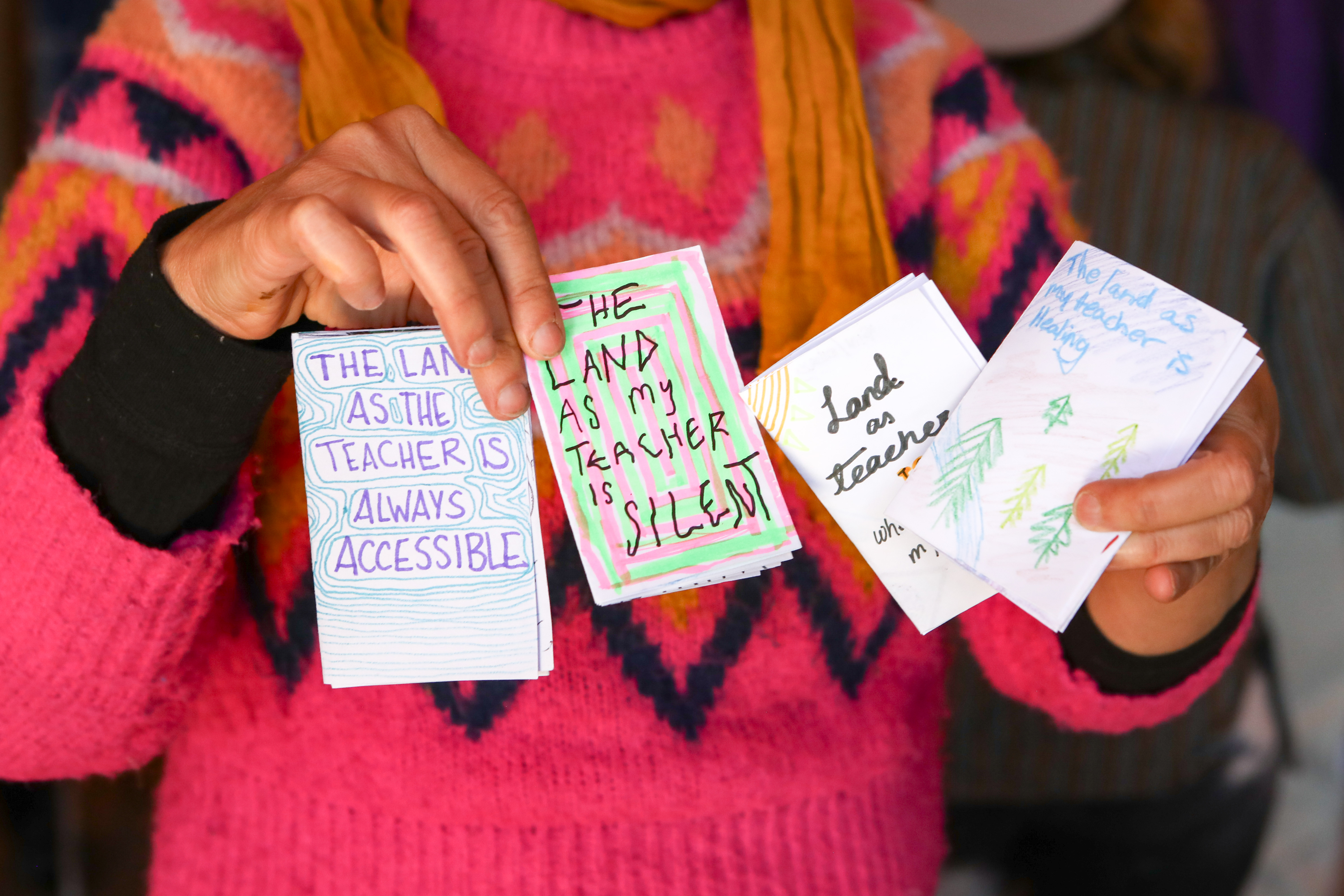
It was a special experience to begin the Earth Sense program and meet fellow participants among the forest, fish, crows, and stars. Co-facilitated by Kelly Terbasket, Carrie Terbasket, Sarah Sandy, Hazel Bell-Koski, and Astrida Neimanis, this initial gathering utilized relational and creative methods to bring participants into the moment and onto the land, creating many spaces for new ideas and relationships to emerge. As our UBCO group reflected on this gathering weeks after, key words came to mind. With each word came many questions, reflections, and growing understandings. Sense. There are many ways to be with each other and with the land. Learning. Not everything is ours to know. Logistics. How can we as activists and academics leverage resources towards this work? Connection. From connections emerge tensions and communities. Spirit. How do relationships to place inform our experiences? Generative. There is a lot to be found in the messiness and tension. Practice. Something happens when we trust the process and the practice, even if we don’t know where we are headed.
Since the September gathering, the UBCO crew has organized two virtual Fireside Chats/workshops with Earth Sense to continue unpacking and grappling with the concept of climate justice together. These workshops have offered UBCO Earth Sense participants an opportunity to translate some of our research/knowledge around climate justice, while also creating space for this research/knowledge to be nuanced, contradicted, challenged, and expanded by the knowledges, insights, research, and experiences of workshop participants.
A Note from Carrie Terbasket:
Earth Sense is a brand-new program for IndigenEYEZ. We are so grateful to those that have joined this first round – breaking trail, learning, and co-creating with us. We have a lot of work to do. IndigenEYEZ believes at its core that the way forward is always through strong relationships, courageous conversation, and creativity. Colonialism or in this context, Climate Justice, is not an adequate container to fit a (in my context) syilx worldview. There are connections to be uncovered, waters to be crossed, skies to navigate and stories to be told. Earth Sense is a journey and contemplation of locating the parts of ourselves needed to find Indigenous-led climate sovereignty pathways – outside of and free from colonial confines.
Check out the IndigenEYEZ website, Instagram, and donation page to explore the learning opportunities they offer and support the critical work they do.
References
Armstrong, Jeannette, and Naomi Klein. 2023. “Armstrong & Klein: Syilx-Led Climate Justice in a Global Context.” Centre for Climate Justice. 2023. https://climatejustice.ubc.ca/news/armstrong-klein-syilx-led-climate-justice-in-a-global-context/.
Armstrong, Jeannette Christine. 2009. “Constructing Indigeneity: Syilx Okanagan Oraliture and Tmixwcentrism.” Doctoral Dissertation, University of Greifswald. urn:nbn:de:gbv:9-001322-9.
Armstrong, Jeannette C., Delphine Derickson, Lee Maracle, and Greg Young-Ing. 1993. “Original People.” In We Get Our Living Like Milk From the Land. 1-16. Theytus Books.
Byrd, Jodi A., and Project Muse University Press eBooks. 2011. The Transit of Empire: Indigenous Critiques of Colonialism. Minneapolis: University of Minnesota Press.
Cohen, Bill and Natalie A. Chambers. 2021. “Emerging from the Whiteout: Colonization, Assimilation, Historical Erasure, and Syilx Okanagan Resistance and Transforming Praxis in the Okanagan Valley.” In White Space: Race, Privilege, and Cultural Economies of the Okanagan Valley, edited by Keyes, Daniel J. and Aguiar, Luis L.M., 35–54. UBC Press. kilawna, kelsie. 2023. “Caretaking the Vast Syilx Homelands.” The Narwhal (blog). December 12, 2023. https://thenarwhal.ca/guardians-penticton-indian-band/
[1] syilx journalist Kelsie Kilawna (2023) writes: “According to some n̓syilxčn̓ language keepers, there are no capitalizations in the spellings of any n̓syilxčn̓ words. In an egalitarian society, capitalization insinuates there is something that holds more importance over another, and that does not fall in line with syilx ethics.” With respect to this protocol and these ethics, nsyilxcən words featured in this blog post are written using lower case letters. We acknowledge that this protocol may differ across communities and contexts.
[2] Beenash Jafri points out that while settlers of colour living on Indigenous lands are complicit in settler colonialism, they do not tend to experience the same privileges as settlers who are white and descendant from Europe. Jodi A. Byrd borrows the term “arrivants” from African Carribean poet Kamau Brathwaite to acknowledge the millions of people who were forcibly and violently taken from their countries and communities and brought to the Americas by European colonizers. Together, these scholars highlight the nuanced relationships different settlers hold to settler colonialism.
[3] “Folx” is a version of “folks” often used to hold space for diverse gender and sexual identities.
 The FEELed lab