This blog post was written by FEELed Lab Administrator Julia Jung.
Knowledge mobilization is the process of transforming academic research into more tangible community benefits. This includes thinking about who is potentially affected by the research, the most accessible formats for engagement, and the timing of engagement activities (Research Impact Canada). As part of a class project in “Knowledge Mobilization and Sustainability Policy” (taught by Dr. Adeniyi Asiyanbi), and in response to a need already articulated by the Lab Director Astrida, we (Julia Jung, Manuela Rosso-Brugnach and Christian Wiewelhove) spent the last few months developing an updated knowledge mobilization strategy for the FEELed Lab. This project was also a fitting complement to my role as lab administrator, where knowledge mobilization is a core part of my responsibilities.
At the same time, our FEELed Lab core member team has also been working on our lab values (read more about this project here). This work, which has included deeper consideration of how and for whom the FEELed Lab’s work has unfurled over the last 4 years and where we want to focus our efforts over the next 4, has thus directly fed into our knowledge mobilization strategy. Developing this strategy has given us the opportunity to think critically about how to update and enhance the processes and impact of our research and engagement.
From the beginning, knowledge mobilization at the FEELed Lab has focused on relationships and co-creation. Using a range of platforms and modes of engagement, we’ve worked to foster reciprocal exchange and localized adaptation. In contrast to more traditional unilateral forms of knowledge mobilization (such as academic paper publication, which we still use where appropriate), our approach has been inherently iterative and participatory: The FEELed Guide and website serve as archives and information portals; our FEELed Notes provide the opportunitiy to amplify the diverse voices or our researchers, partners, and students; while our Instagram account has been useful to extend our tendrils of community virtually. In these ways we have aimed to combine community engagement with interdisciplinary research.
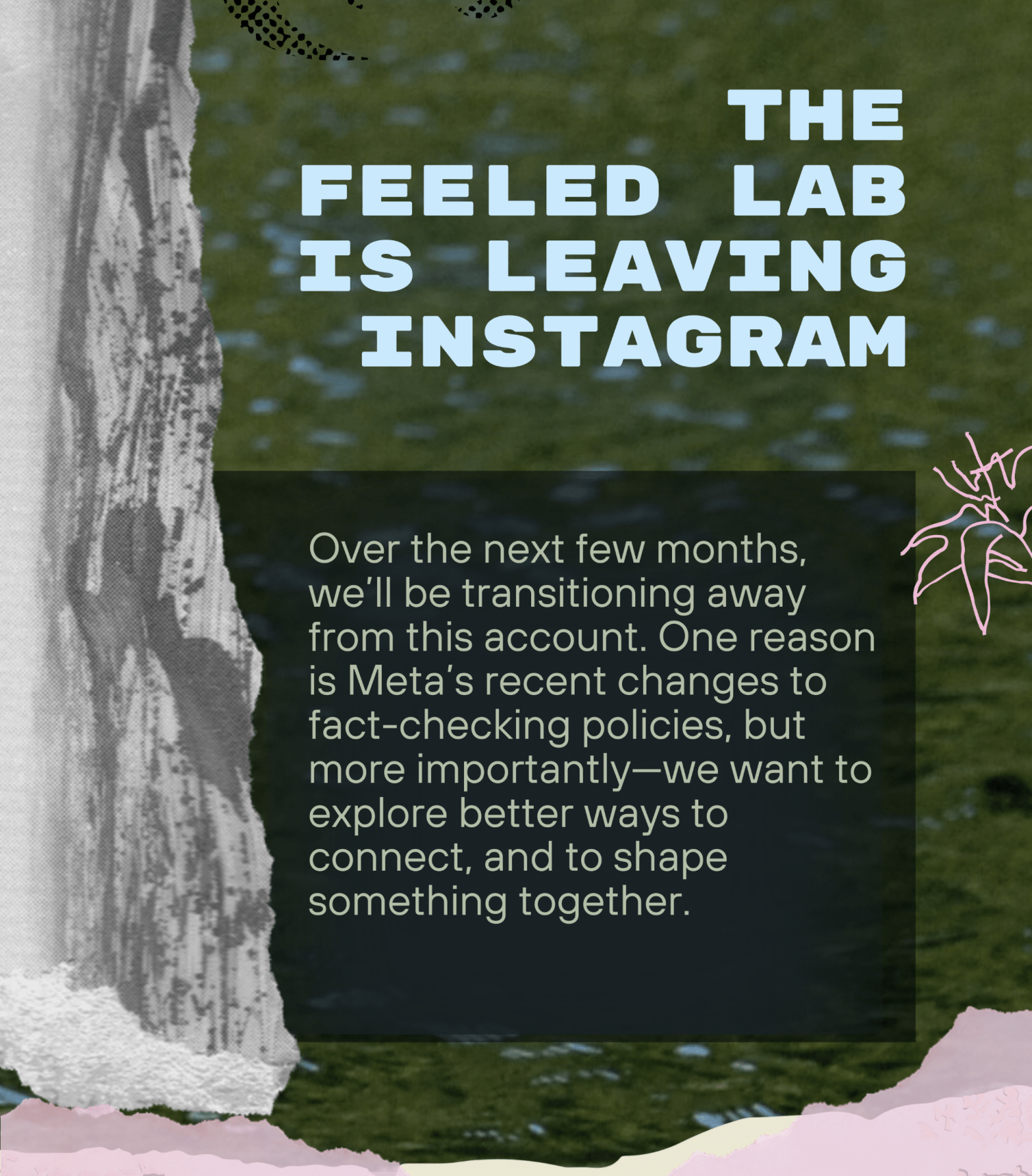
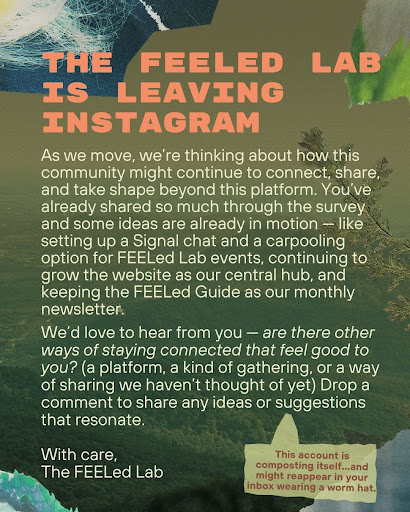
While all of these tools have been valuable in their own ways, many Lab members have had growing uncertainties about the role of Instagram in our community – especially as this platform has itself been changing. Meta’s decision to end their third-party fact-checking program in January 2025 and the coincidental timing of the start of this project felt like a good point to explore leaving Instagram more concretely. Even though Instagram has been an important way of connecting with our community, we don’t want to continue supporting a billionaire-owned platform whose algorithms promote social media addiction and censor marginalized communities (even as we recognize the role it still plays for many people; our decision does not subscribe to purity politics!).
One key question we explored throughout this project was whether we should migrate to an alternative social media platform such as Mastodon, BlueSky or PixelFed. While pondering this question, we were lucky to connect with Ali Yazdizadeh, a PhD candidate in Digital Arts & Humanities at UBCO, who researches algorithmic capitalism and its consequences. Ali’s research confirmed what we had been suspecting: that there isn’t and won’t be a suitable alternative. Even though alternative social media platforms might not be billionaire-owned and more decentralized, they are still built on similar addictive principles. Moreover, as their underlying algorithms are usually not as personalized, the content they provide to users is often not as satisfying. Ultimately, the only way alternative social media could replace our current dominant platforms like Instagram, Facebook and X is by becoming them. (Don’t just take our word for it – we encourage you to read more about this in Ali’s publications!)
Our strategy is instead focused on creating alternative ways to connect more meaningfully using a range of strategies. Potential ideas and actions include an Instagram Legacy post series detailing our reasons for leaving and responding to some questions and concerns from the survey; setting up a “Tools & Methods” archive on our website; and developing our “Outstanding Feelz” undergraduate essay series into an official FEELed Lab magazine. We have even discussed returning to hand-made snail-mail missives sent to actual postboxes! (Would this interest you?)
We suspect this process might also be interesting and relevant for other labs and practitioners, so we plan to publish our knowledge mobilization strategy alongside a feedback form in our May newsletter. We also intend to organize an open forum on knowledge mobilization to discuss these ideas in relation to anticolonial feminist values and community-building more broadly – so please stay tuned! (In the meantime: your comments are welcome!)
 The FEELed lab