
This blog post was written by FEELed Lab Research Affiliate Susan Reid, who is currently undertaking a postdoctoral fellowship at UBCO.
It is pretty incredible to think that one year of my postdoctoral fellowship with UBC’s Faculty of Critical and Creative Studies has unfurled. This post offers some research reflections and notes about the felt-field work that took place.
A motivating context for my research is the rising tide of resistance against extractivism, colonial capitalism and related architectures of modernity and their cumulative barbarism against allkinds. The fellowship enables me to extend and deepen commitments that support this movement through creative and scholarly responses. At the moment, it is helping with research that extends my concept of multibeing agency. This is also salient to the above commitments, because there’s nothing that an extractive regime likes doing more than denying certain beings and embodied worlds their agency.
Western technoscientific prescriptions of agency notwithstanding, the term ‘agency’ seems to slide around a bit within the environmental humanities. In my use of agency, I precede it with the term multibeing to give it a more relational dimension. This isn’t ground breaking. Indigenous cultural practices and knowledges lead the way and uphold lived kinships that radiate connections across worlds.
In my cultural critiques of ocean governance, I examine how and where state practice and legal regimes deny both ocean agency and the potential knowledge contributions of Indigenous leaders. I work with others to resist/redress these extractive, colonial (ill)ogics. In diplomatic and regulatory arenas, such as the International Seabed Authority. Indigenous representatives are also leading the way through interventions advocating for more respectful ways of relating to the ocean.
As a scholar of settler heritage, I’m committed to enabling spaces that foreground Indigenous voices and worldviews. But I also recognise the potential to rely on the labours of Indigenous thought leadership, and articulations of particular relationships formed with specific places histories, and others, without investing my own translational labours. How do I navigate the situated and affective ways that I conceive and connect with different worlds? What animacies and inanimacies do I attune with and toward, and with which embodiments and desires?
Field work is critical to this work. It’s easy to feel a sort of bone-deep gloom about the ongoing devastations of extractive, colonising modernity on human and other communities. Felt-field work offers time to re-calibrate. I call this felt-field work because, at some point, it enables me to walk into a different felt-self, more able to sense the edges of being opening again to imagine toward, if not meet, other worlds. It doesn’t happen straight away. Usually, it takes about an hour before I’m again able to sense the multibeing dimensions of embodied worlds; and to meet and imagine with them through different membranes of attunement.
Felt-field work is an epistemic strategy for investigating multibeing agencies and kinships and their legibilities. It allows me to engage and create artistic responses that reveal material and social kinships and expressions of agency at multiple scales and genres of being. As a visitor without lived experience of these places and situations, I’m mindful that these observations and experiences are in a moment of tide, season, or hour of the day/night.

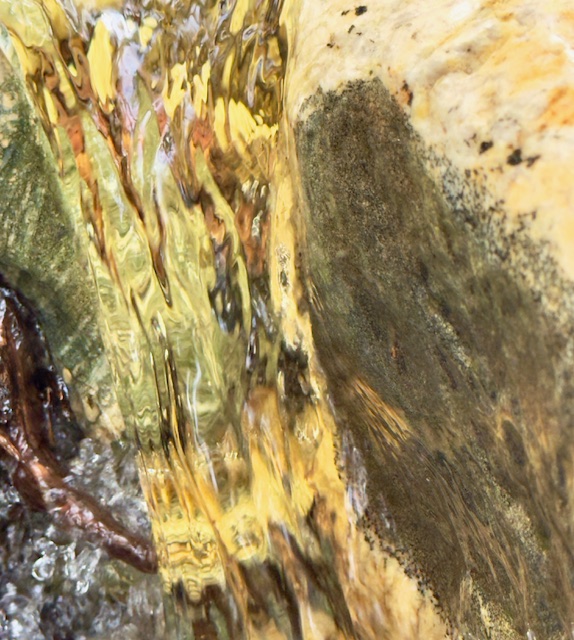
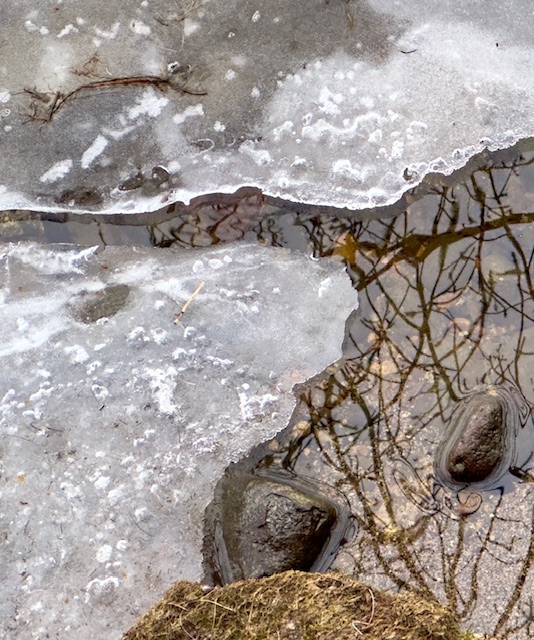
For the most part, I photograph with a mobile phone camera because it allows me to less intrusively emplace my body in field situations. The camera extends with me and allows intimate responses to the invitation of place: kneeling or wedging into rock crevices, meeting the sea-edge with horizontality by lying flat on surfaces slippery with seaweed, clambering up steep embankments, or balancing between rocks and river rapids. For stability, I mostly rely on parts of my body–propping the device on my knee, supporting it with my shoulder, ankle, or arm.


In the context of multibeing ocean agency, my experiences and field work are limited to near seas–where I can walk, swim, paddle or sail. Thinking with the remote ocean, is not so easy without lived, generational experience or knowledge of the particular relational modes and vulnerabilities of deep constituents. I rely on correlations of near shore experiences and a situated, informed imagination shaped by insights gleaned from others–Western marine scientific material, Indigenous cultural knowledges, and speculative insights offered by artists and writers. Nevertheless, field work creates opportunity for immersion with sea edges that bring waters and particulate missives from the deep–for example, the water lapping at my feet, likely pressed and travelled abyssal sediments over past millennia.


When in Kelowna, (BC interior), discerning oceanic presence is equally challenging. As with sensing remote hinterseas from the shore, correlations and subtle connections are sought. As well, felt-field walks focus attention on the alto and cumulus clouds voyaging inland. Those coming in from the west, in particularly carry oceanic waters and particles. Their shadows brush the hillsides and offer fleeting oceanic-shelter to fire-stubbled landscapes.
 The FEELed lab