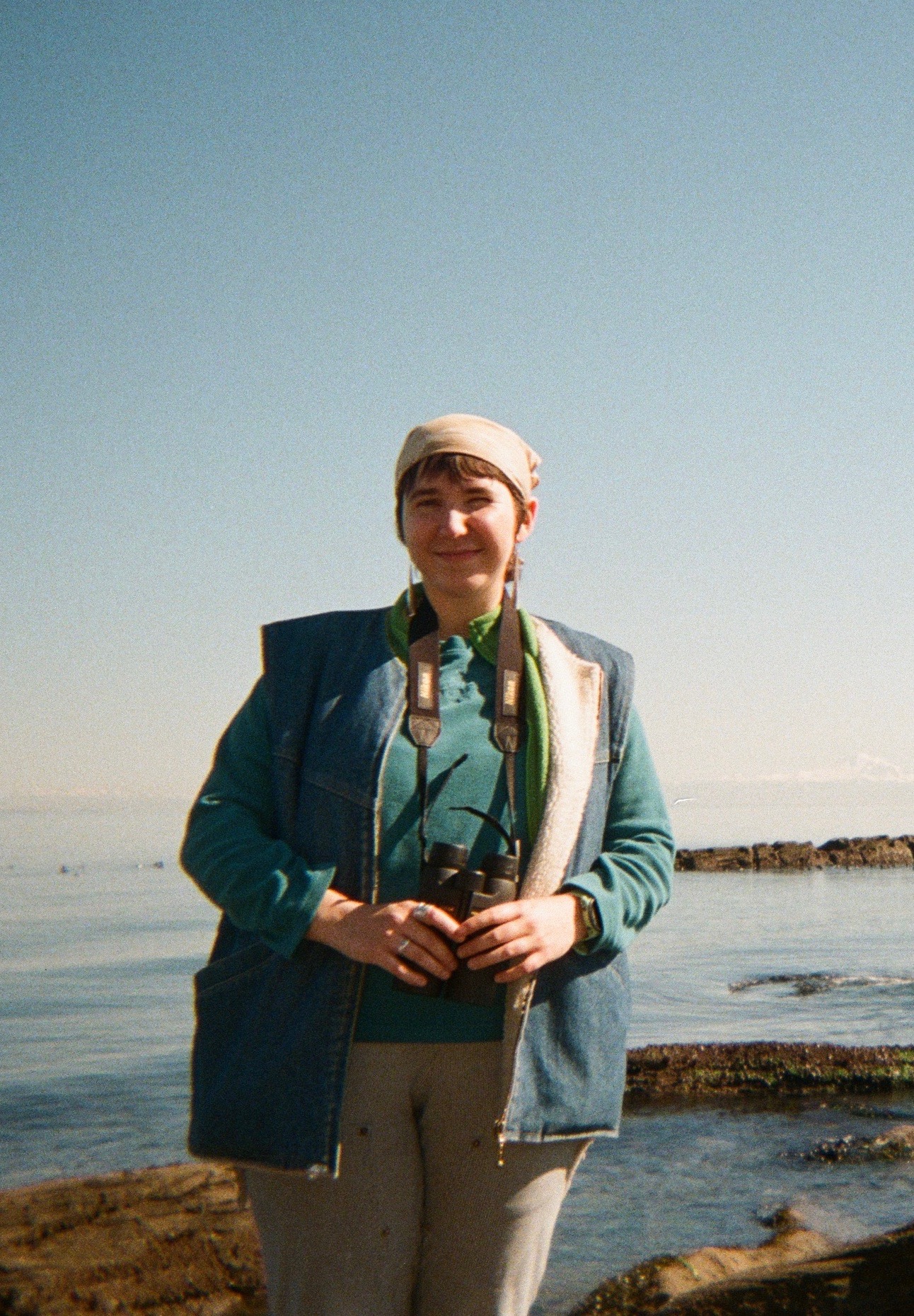
As we welcome new people to the FEELed Lab, we want to make space for longer introductions to project team members and research affiliates joining us this year. This profile is on Meghan Reyda-Molnar, who is joining the FEELed Lab as a research assistant and affiliate for our FEELers Summer camp and is currently doing her MFA at UBCO.
- Can you tell us about your work/research?
My current thesis work in poetry uses grief as a header to connect seemingly disparate experiences of loss and the potentials held within responses to those losses, in order to try to uncover a grieving process able to honour the interwoven nature of the personal, political and ecological. Transitioning from working in oceanography and chemistry the past five years, I feel there is a need for art that deals with changing ecological futures, that allows in the messy, complicated relationality that scientific research tends to avoid. My research is interested in how we measure and record loss across in our personal lives, in science, in organizing spaces, in poetry—trying to observe what is shared and how different kinds of responses affect how (or if) we believe we are able to enact change.
Materially, my work will involve pouring back over the scientific research I have done, remembering my own experiences of grieving within personal/political contexts, researching historical grieving practices within my ancestry (predominantly Irish/Hungarian), reading queer theory, and writing poetry. Lately, I have been especially interested in the concept of queer time, and the interplay of this with extended experiences of grief and of being at sea performing fieldwork—how water as a metaphor is able to help us think about the connectedness of spaces and bodies.
2. Why did you want to work with the FEELed Lab?
Working with the FEELed Lab felt like a natural step when I moved to Syilx territory this past fall and heard about the lab through the different events being hosted here. Immediately I had a sense that this was a space that would allow me to bring all aspects of my work with me—the scientific, the political, the queer-feminist, the personal—and that would connect me with people who value finding the resonances between those things. It feels exciting to be a part of a community that is committed to interdisciplinarity, to the decolonial and accessible, and open to the sort of paratactical learning that can happen when you allow overlap between identities, commitments, and categories.
3. Why are expansive engagements with environmental issues important?
I think this question played a large role in my transition from working in science to writing poetry. I was struggling in my research to feel like I was connected to the waterways I was working with, or to be allowed to honour that connection, because it felt like it would break through constraints placed on the research I was doing to be impersonal, objective, truthful. I think the more reading I do in the feminist environmental humanities, the more I think that it’s nearly impossible to tease apart our relationships to nature and culture, and that in order to engage with environmental issues in a way that has the capacity to effect change, one must be able to feel how interwoven they are with all the other aspects of our lives—how they affect our families, our food, the places we’re emotionally connected to, the animals we share experiences with.
 The FEELed lab