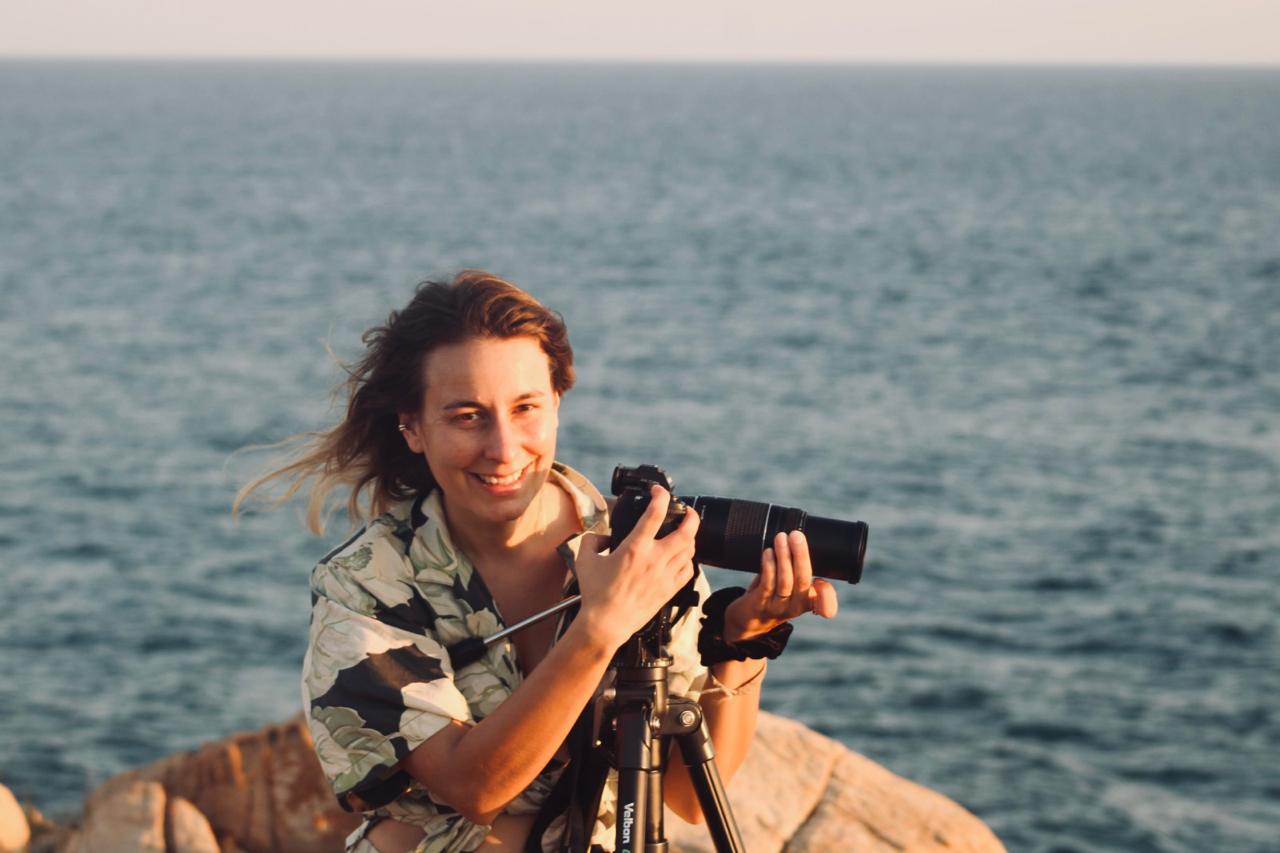
As we welcome new people to the FEELed Lab, we want to make space for longer introductions to project team members and research affiliates joining us this year. This profile is on Clara Kleininger-Wanik, who is joining the FEELed Lab as a visiting artist and researcher in August 2025.
- Can you tell us about your work/research?
Currently I am working on my PhD research, which asks how the relationships humans and other animals make in the Chacahua lagoon, on Mexico’s Pacific coast might be represented in a documentary film which shows the lagoon as an interrelated matrix of multispecies agency and interests. The Chacahua lagoon is one of Mexico’s oldest national parks, declared so in 1937, and my research engages with the multiple worlds which meet in Chacahua: conservation practices and biological knowledge, the ontology of being tonal, sharing life with a particular more-than-human animal in the lagoon (what happens to one partner of the bond happens to the other) and the Afromexican fight for autonomy and recognition in the lagoon and the wider Costa Chica area, as the environmental destruction experienced in the lagoon has been described as environmental racism and conservation practices have failed to work from and respect local environmental knowledge.
I draw from several disciplines, starting from my background in (visual) anthropology, engaging with film studies and science and technology studies to make a collaborative, visual, multispecies ethnography. The filmmaking is designed as a participatory endeavour, based in feedback screenings and long term co-creation with several Chacahuans engaged in conservation and monitoring activities.
At the UBCO I will extend my reflections of how multispecies relationships and dependencies can be brought to film as well as how the qualities of water (defining for Chacahua as a waterworld) or its lack can be represented, through investigating the drought, its causes and effects on multiple species in the Woodhaven park, the FEELed Lab’s home.
2. Why did you want to work with the FEELed Lab?
I am excited to be able to connect and share with the scholars and artists who are part of the FEELed lab, as I can see many common threads of interest and approach: a desire to challenge anthropocentrism while not losing situatedness in diverse bodies and voices, which is central to my current research and I hope to continue thinking through while at the lab, as well as the lab’s continuous appreciation for sensory, embodied and art-based engagement with the environment which are also my core preoccupations and more. I look forward to learn from the crossing of disciplinary boundaries (which I am enthusiastic about and have known to be both challenging and fertile) and hope to contribute some of my own sensory, audiovisual discoveries and encounters of a place already well-known to the other members.
3. Why are expansive engagements with environmental issues important?
In my research, I start from the assumption that more-than-human and human interests can benefit from being considered together instead of at odds. Ideas of animality and a separation of nature and culture have been historically used to dominate human and more-than-human others as well as led to many of the environmental issues we are facing. Proposed solutions that ignore the knowledge systems behind them, especially those that bypass decolonial, Indigenous, and feminist critiques, risk reproducing the very logics and hierarchies that caused these problems in the first place. In this way, I understand expansive engagements as both discussions which involve points of view from across disciplines and outside of academia, as well as a recognition of the importance of what stories are told (and, with them, the place of artistic methods) in confronting environmental issues: “It matters what matters we use to think other matters with; it matters what stories we tell to tell other stories with; it matters what knots knot knots, what thoughts think thoughts, what ties tie ties. It matters what stories make worlds, what worlds make stories” (Haraway, 2013).
Haraway, D. (2013). SF: Science Fiction, Speculative Fabulation, String Figures, So Far. Ada: A Journal of Gender, New Media, and Technology, No.3. doi: 10.7264/N3KH0K81
 The FEELed lab