
This FEELed Note was written by FEELed Lab member Tom Letcher-Nicholls.
Over the summer break, and as part of the FEELed Lab’s ongoing Lab Values project (How we are and wish to be: our FEELed Lab Values – The FEELed lab ; What do we actually mean? Diving deeper into our lab values using Storytelling – The FEELed lab), I set out to produce a zine or a page of a zine that explored one of our emergent lab values.
From July to August, I swapped the Okanagan’s summer to spend winter and spring with my family in Melbourne—or Narrm in the language of the Wurundjeri Woi Wurrung people, the traditional custodians of the land that I grew up on. And so, being between these places, I chose to create my zine in response to the value: “We are committed to this place while also thinking about what lessons can travel elsewhere!” This value is also essential to my thesis research, in which I am exploring how different places—and above all our obligations and relations in and to those places—might shape literary and ecocritical methodology and method.
In thinking about how to respond to the lab value I was exploring, what stuck with me was the change in the seasons. Usually when I tell people I am going to Australia for the summer break, we end up talking about how I am swapping summer for winter. But while August is still very hot in the Okanagan (and feels like the month of fires), it is not at all the dead of winter in Melbourne/Narrm. In August the wattle begins to bloom, signalling the beginning of spring.
I think this relates to another of our emerging lab values: “We watch for unexpected unfurlings.” Indeed one of the key unexpected unfurlings for me in moving to Canada and the Okanagan has been the way I pay attention to the seasons. In Australia, I don’t think I ever truly gave much thought to the changing of the seasons, perhaps because Melbourne/Narrm’s seasons do not change as dramatically or extremely as they do in the Okanagan.
I think this relates to another of our emerging lab values: “We watch for unexpected unfurlings.” Indeed one of the key unexpected unfurlings for me in moving to Canada and the Okanagan has been the way I pay attention to the seasons. In Australia, I don’t think I ever truly gave much thought to the changing of the seasons, perhaps because Melbourne/Narrm’s seasons do not change as dramatically or extremely as they do in the Okanagan.
In 2023 and 2024, I took nsyilxcən language lessons through Kelowna museums with syilx knowledge keeper Jasmine Peone (absolutely check out the syilx led events through Kelowna museums!). As part of those lessons, we learned about the syilx 13 moon calendar. Below is a photo:

In making my zine, I decided that I wanted to put the syilx calendar into conversation with the Wurundjeri calendar, which I have only recently learned about. Furthermore, I had just read that Melbourne’s Mayor had suggested that he will consider adopting the Wurundjeri peoples’ calendar (First Nations Seasons – Behind The News).

And so when I went to make my zine, I very imperfectly tried toput the syilx and Wurundjeri calendars in relationship to one another (and because I am bad at zine-ing I missed two pages so made some hasty illustrations). Below are images of the zine I made:
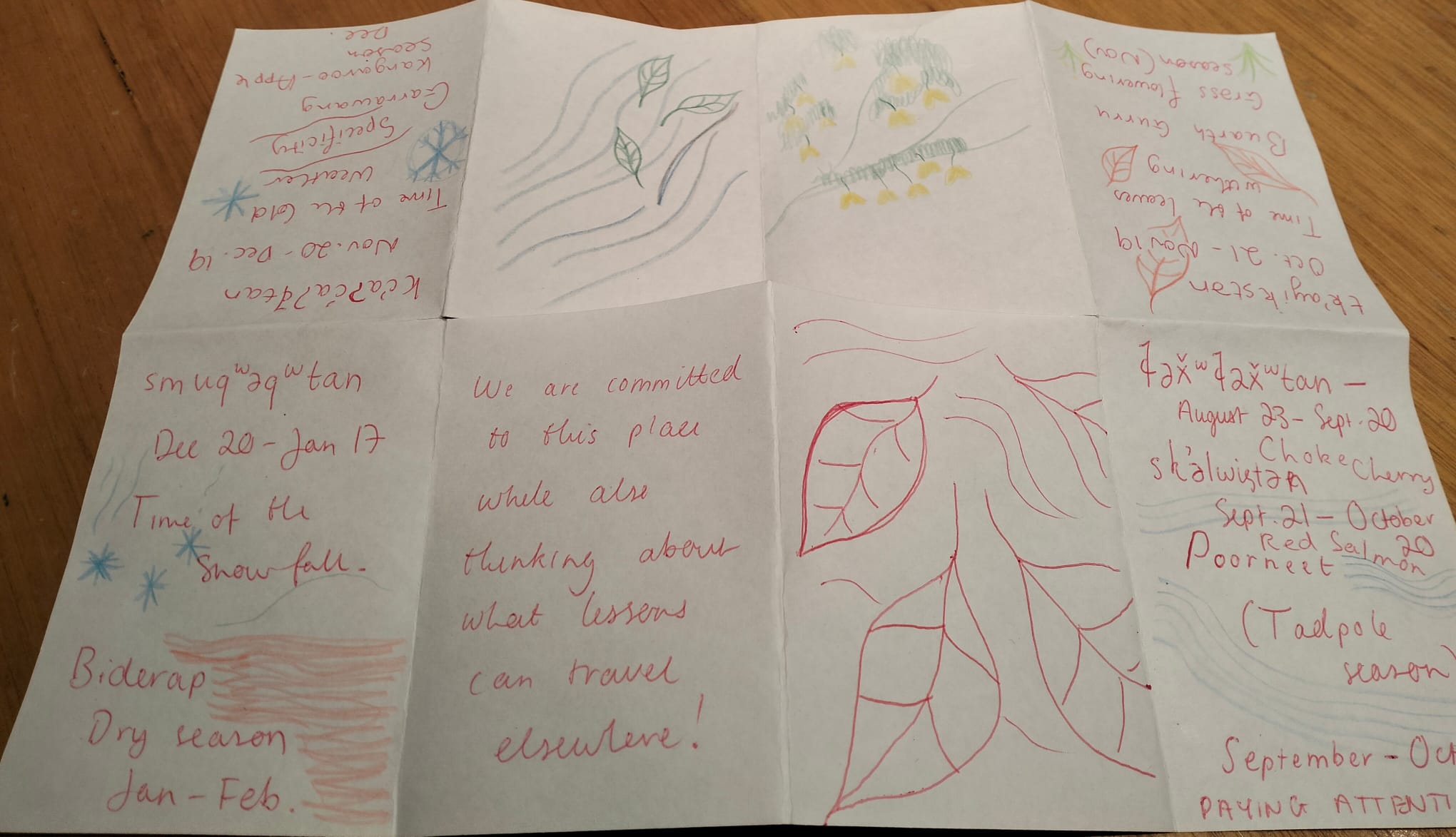
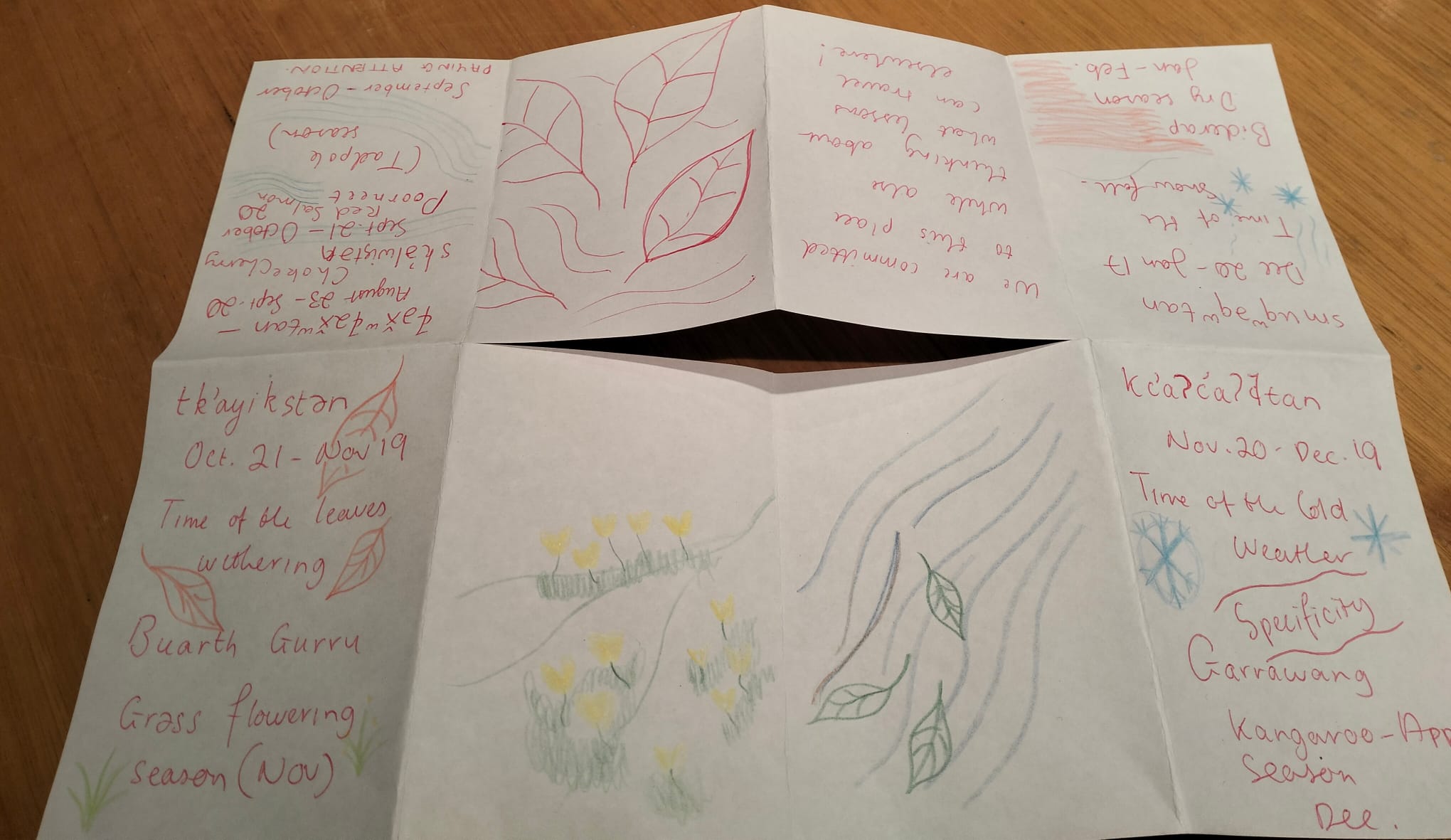
One of the effects of the zine is that the zine reads cyclically—you turn it around to read the different seasons—which reflects the turning of the seasons. Of course, because the Okanagan is in the northern hemisphere and Melbourne/Narrm is in the southern, the seasons are almost inverted. But they are not exactly opposite; partly because the syilx calendar follows the moon cycle, but also because they are such deeply place-based calendars, tracking specific changes in these two places in different increments of time.
As part of my thesis project, I am hoping to craft a number of “Unlearning Essays,” a method that I learned from Christine McFetridge’s 2024 PhD Dissertation “An Inconvenient Curve: Unlearning Settler Colonial Representations of Birrarung”. McFetridge is a white settler from Aotearoa New Zealand who lives in Australia, and her dissertation explores and unsettles settler representations of Birrarung, the river that runs through Melbourne. Her “Unlearning Essays” draw on feminist scholar Sara Ahmed’s concept of the “double turn,” which McFetridge describes as “compris[ing] an inward turn (critical self-reflection) and an outward turn (turning towards others)” (17). As Ahmed writes (2004):
In other words, the task for white subjects would be to stay implicated in what they critique, but in turning towards their role and responsibility in these histories of racism, as histories of this present, to turn away from themselves, and towards others. This ‘double turn’ is not sufficient, but it clears some ground, upon which the work of exposing racism might provide the conditions for another kind of work.”
When thinking about writing my own “Unlearning Essays,” I considered writing four — specifically to reflect the changing of the seasons. But then I thought: whose seasons? Arguably the four-season calendar has been imposed from Europe on lands and territories where the usual summer, autumn, winter, spring cycle just does not describe the changes the land goes through.
Attuning to the place-based syilx and Wurundjeri calendars has helped me pay closer attention to the specificities of the different places that I live. My relation to the land of the syilx people and Wurundjeri country is that of a settler, and I have so much more to learn about these places and what it means to be here. The knowledge held in these calendars is not my own, but it is my hope that in a halting but steady way I can learn to move with intention, responsibility and care in these places.
Right now in the Okanagan it is sk’əlistən: the “Time of the Red Salmon,” the moon cycle from September 21 – October 20. As I try to do each year, I visited Mission Creek to see the salmon travelling upstream to spawn. I was reminded of the resilient rhythms and cycles of life in this place, despite all the damage wrought by processes such as colonialism, capitalism, and resource extraction. All these processes have also occurred in Melbourne/Narrm, where it is now Poorneet, or tadpole season, which runs from September to October.
And so, although they are in completely different hemispheres and seasons, both these places are currently undergoing cycles of transformation and developing new life: salmon fry and tadpoles spawning in the Okanagan and Melbourne respectively. This has been enabled by the hard work of communities, and especially the First Peoples of these places. As the season changes, I hope everyone reading this can take the time to attune to themselves and to the places that they love. Happy autumn everyone.
 The FEELed lab