
This FEELed Note is part of our occasional series featuring outstanding feelz from undergraduate students.
Transformations by Nadia Huggins is a series of diptychs. Diptychs are artworks consisting of two panels that, when put together, create a whole art piece. There are eleven sets of panels here, each of which produces an image through entanglement, reflections and extensions of both human bodies and the marine ecosystem. These images depict the complexity of human nature: how a human body can extend into a sea urchin, a type of coral reef, but also how the nature of the sea can melt into different elements of the human body and still belong there.
I did not see our bodies as moldable and beautiful, wild and subversive, each element searching for connection with the other. But, in how our human bodies twist and morph and melt into the water, we have been that marvelous all along.
This series of diptychs combines the self-portraiture of the artist Nadia Huggins and the documentation of marine organisms in relation to each other. It is worth noting the artist’s politics of location and how that influences the execution of Transformations.
In the sea, as a woman who identifies as other, my body becomes displaced from my everyday experiences. Gender, race, and class are dissolved because there are no social and political constructs to restrain and dictate my identity. These constructs have no place or value in that environment” (Huggins).
Here, the marine ecosystem allows the body to be weightless and create meaning within the medium, whereas the sea, like bodies, are also unknown to the naked eye. This feeling indicates relations between the sea and the human body in this artwork due to their mutuality and intermingling.
Nadia Huggins’ body slipped beneath the sea and acted as a whole image with the ecosystem. What does this tell me about how my body identifies with the sea? What is kin to me, and how are we intertwined? Upon thinking about the relationship between the land and bodies in the art, I resonate with the concept of kin. Kin, here, relates to the relationship between environment and bodies and how they are kin with each other.
According to Alexis Pauline Gumbs, the author of “Undrowned: Black Feminist Lessons from Marine Mammals,” her hope is for us to move away from “identification, also known as the process through which we say what is what” and instead move to “identification, that process through which we expand our empathy and the boundaries of who we are become more fluid because we identify with the experience of someone different” (8).
On reading this line, I asked myself a question. When a marine mammal is hunted for its blubber, who do humans identify with? The animal, blood drawn, or the hunter? It is ‘violent to be known’.
With Gumbs’s idea of radical empathy, I hope that we see ourselves as the animal because of the capitalistic systems already bleeding us dry; I hope we see them, and all else, as kind. I understand kin as a verb, where one actively accepts the mutuality we have with each other amid humans’ active drowning by finding ways to survive within systems of oppression alongside our kin, which we may not recognize as kin, as an answer. Gumbs explains it as a move towards kinship in a shared context:
This is an offering towards our evolution, towards the possibility that instead of continuing the trajectory of slavery, entrapment, separation, and domination and making our atmosphere unbreathable, we might instead practice another way to breathe” (Gumbs 2).
The same systems that lead us to be unable to breathe, function, live and play are the same ones that isolate and violate the lives of the sea and its ecosystems. How could we not see them as kin?
Upon a close look at Transformations, my initial response is to note how the two panels simultaneously extend and reflect the human body and the marine ecosystem. Some of the panels depict a possibility of surrender, the ability to let go and be whole with nature instead of against it. This other side of humanity can be seen through the weightless freedom of the sea, separated from the politics of suppression and capitalistic force.
Some panels like 1, 2, 6 and 8 display how the human body leans into the ecosystem and how, instead of resisting the tide of nature, it allows the flow to occur, becoming kin: “What it would take to tune in with our environment enough to be in flow with the Earth instead of struggle against” (Gumbs 121).
In that same light, panels 3, 4, 5 and 10 show me again what that act of letting go would look and feel like: a balanced world where humans do not fight against nature but instead identify with their role of existing within nature and being kin with bodies of water, expressly.
Kin expresses much of what is unsaid and unseen by the naked eye, and this series of images portrays that expressly. It is also worth noting that this idea of finding connection, or kin, can be identified in the artist’s statement:
Most people’s experience with the sea occurs at eye level with the horizon, and they are oblivious to what is happening below the surface” (Huggins).
This also applies to human nature: by denying the connection of kin and being seen, we keep ourselves at eye level. If we allow ourselves to be kin with the sea, coral, and sea urchins, we enable our bodies to be held by something more than us. We can hold onto an entirely other thing. We are permitted to practice radical empathy.
By letting our bodies become kin with something more than each other, we engage in enmeshment. By being kin, we also become intertwined and dependent upon each other for communion, a community. Stacy Alaimo, a scholar of environmental humanities, defines transcorporeality as intense enmeshment:
Transcorporeality does the opposite of distancing or dividing the human from external nature. It implies that we’re literally enmeshed in the physical material world, so environmentalism cannot be an externalized and optional pursuit” (Alaimo 139).
The enmeshment is not simple or easy. It recognizes that our survival is tied to each other: that I can only be whole when you, the sea, the coral, are safe. When the tide is rough and angry, and my family, who caused this with their fishing, looks away, I think we should not separate from the environment. No matter how hard we try, we are enmeshed in it. Global capitalism will never give us life’s answer, but what births us may have the answer we seek.
Transformations enable us to envision what this transcorporeality can look and feel like: the art pieces may combine to create a whole image, and those whole images can help us express what is hidden by the human body. In the context of those images, I cannot help but wonder how transcorporeality reveals what cannot be seen alone in either instance. How does it highlight what is not seen in the human body and what is missing in the marine?
In specific panels of the art series, the marine ecosystems act as extensions of feeling and presentations that humans cannot inhabit, physically and emotionally. In panel 1, the flat human body is contrasted by the spikiness of the sea urchin, showcasing what a human body might be hiding underneath the surface, beneath the sea level. Panel 3 shows us the textures and the layers of the human body, all the details neglected by how society treats our bodies.
By being transcorporeal, humans learn that there is more to experience than the hardships our body puts us through. There is more, that there has always been more, and within those depths of discovery, a wholeness of body and mind emerges.
WORKS CITED
Gumbs, Alexis Pauline. Undrowned: Black Feminist Lessons from Marine Mammals. AK Press, 2020.
Huggins, Nadia. “Transformations .” Transformations, nadiahuggins.com/Transformations.
Tofantšuk, Julia Kuznetski and Stacy Alaimo. “Transcorporeality: An Interview with Stacy Alaimo.” Ecozon EU: European Journal of Literature, Culture and Environment, ecozona.eu/article/view/3478. Accessed 21 Mar. 2025.
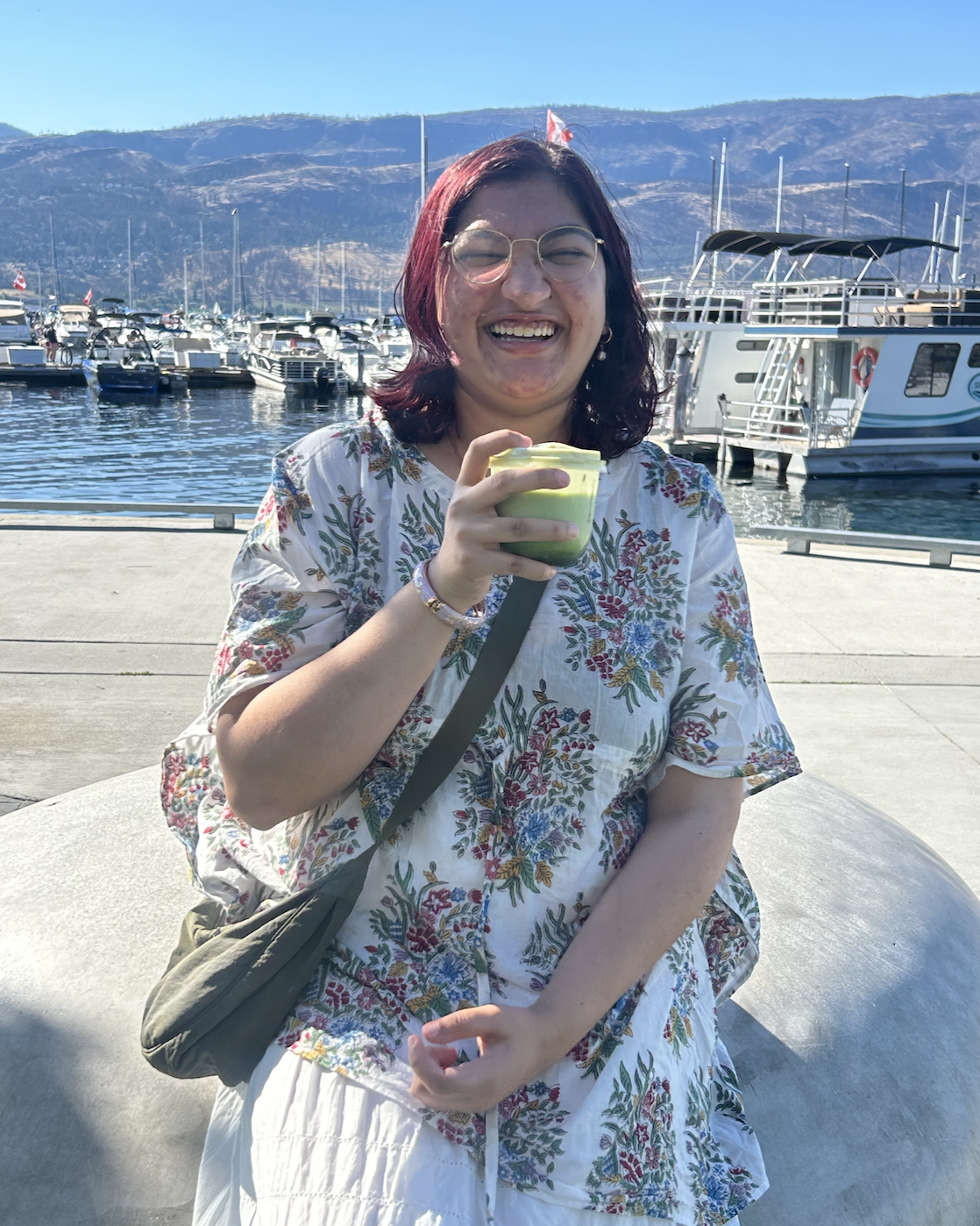
My name is Soha Aftab, and I’m an undergraduate student at UBC Okanagan, studying English and Cultural Studies. When I am not attending lectures on the traditional, ancestral, unceded territory of the Sylix Okanagan Nation, I spend time listening to music, spending time with my friends and making my way through my large collection of unread books!
 The FEELed lab