
As part of our knowledge mobilization project, our Instagram has finally gone fallow. Instead of deleting our account, we are composting it through our Instagram Legacy Art Project. The project consists of a composite collage of 9 individual Instagram posts created by Manuela Rosso – Brugnach with associated captions curated by Julia Jung and edited by Astrida Neimanis. Each post explores a different facet of why we’ve chosen to let our Instagram account go fallow and how we feel about that.
You can explore the posts and their captions below:
But how are we connected? We would like to connect differently with you. We are letting our Instagram account go fallow, in order to direct our energies towards exploring new ways to connect – with each other and the places that support us.
Are you curious about exploring this with us? Please visit the FEELed Lab website, sign up for our monthly newsletter, or email us! (see links in bio)
If you reach out and we take a beat to respond, we may have just popped outside to watch the coming snow fall…
In this spirit, we leave you with Michi Saagiig Nishnaabeg musician, writer and academic Leanne Betasamosake Simpson’s description of sintering, as we continue to learn from the land about how to connect creatively:
“The first thing a snowflake does when it lands from the skyworld is to join bonds, actual physical bonds, with its neighbours.
It weaves itself into its environment, and it does so in a way that doesn’t destroy its neighbours.
Sintering is bonding; it is building coalitions with your neighbours.
And these coalitions mean that the packed sinter snow on the trail has staying power, that it remains long after spring has melted the snow around it.” (p. 18)
And we encourage you all to take a Snow Day!
Simpson, L. B. (2025) Theory of Water. Alchemy.
Citations curated by Julia Jung; Collage created by Manuela Rosso – Brugnach
UBCO graduate researcher Ali Yazdizadeh has been helping us figure this out. He reminds us that:
“Digital landlords rein over the digital commons and data serfs, but under this feudalism the digital fields or factories masquerade as social networking spaces. The serfs’ main field of labor is corporate social media, and labor is extracted from the endless stream of their every click, like, share, comment and engagement.”
Geez, aren’t we already working too much?
Ali continues:
“Toiling under the omnipresent eyes of algorithmic sentinels, the data serfs are not just observed but anticipated, their desires are not just directed but hijacked, their biases are not just reinforced but normalized, their fears and uncertainties are not just provoked but exploited, their perception is not just distorted but reconstructed, all to align with the imperatives of a system that thirsts for profit maximization.”
Ali points out that “what is perhaps missing is the language to articulate the possibility of resistance within the circuits of algorithmic control.”
We agree! We looked into possible alternatives such as BlueSky, PixelFed or Mastodon, but Ali’s thesis led us to realize that there is probably no suitable alternative (for now). The only way for an alternative social media platform to become as vibrant, juicy and popular as Instagram is for that platform to literally … become Instagram! And then we’re right back where we started. So, instead we will muddle slowly along, keeping our eyes and ears peeled for other ways to resist.
Digital Organs without Bodies: On Algorithmic Capitalism and its Consequences by Ali Yazdizadeh
Citations curated by Julia Jung; Collage created by Manuela Rosso – Brugnach
But that doesn’t mean we aren’t also sad about going fallow.
We connected with so many amazing ideas, people, and organizations through this little ol’ magic box. This is how we found new friends to join us at “Listening, Attuning” in 2022, or at “FEELers” in June 2025. This is how we made reading groups across timezones, and where we were invited to take part in other things, elsewhere, initiated by you! We recognize that this kind of digital connection also offers accessibility in ways that are sometimes tricky to replicate.
So we are also grieving the possibility of the connections unrealized, and we already miss those of you we may not connect with again.
If you are also feeling (even just a little twinge!) sad about the fact that we are going fallow, please reach out to us to say connected (links in bio). We pledge to keep cultivating accessible and remote ways for joining our community!
Sometimes a poem can hold what Instagram captions can’t quite manage:
awaken to the gently unstoppable rush of rain landing on roofs, pavement, trees, porches, cars, balconies, yards, windows, doors, pedestrians, bridges, beaches, mountains, the patter of millions of small drops making contact everywhere, enveloping the city in a sheen of wet life, multiple gifts from the clouds, pooled over centuries and channelled to power us, rain propels our water-based bodies that eat other water-based bodies, mineral vegetable animal. when i turn on the shower, i turn my face and shoulders toward post-chlorinated rain. the tap releases free rain to slake our thirst, transformed through pipes and reservoirs. anonymous agent of all that we, unwitting beneficiaries, do. refusing the inertia of amnesia, i welcome the memory of rain sliding into sink and teacup, throat and bladder, tub and toilet. bountiful abundant carrier of what everyone emits into the clouds, be that exhale or smoke, belch or chemical combustion, flame or fragrance, the rain gives it all back to us in spates, a familiar sound, an increasingly mysterious substance
– Flush by Rita Wong
Maybe “Flush” holds something of the Instagram vibe on a good day–that rush of connection, and the buzz of having so many beautiful and heartbreaking moments unfold in your palm. We are grateful in the knowledge that the rain will continue to give it all back to us in new ways, too.
Wong, R. (2015) undercurrent.
Blewointment publishing.
Citations curated by Julia Jung; Collage created by Manuela Rosso – Brugnach
What are the nutrients in this compost pile? We hope you will still find here the peels and pits of our events, the transmutating scraps of our unfurlings, and in time, the rich mulch that will feed versions of our values and actions in new gardens. Maybe these new gardens will grow things similarly based on the hydrofeminist principles that are the substrate of all our FEELed Lab research, as we muck about with the messy and necessary amplification of feminist, queer, crip, anticolonial, and antiracist goodness in all things “environmental” and “sustainable.” And we hope we might find a zucchini or two on our doorstep one day, maybe from your garden!
Hamilton, J. & Neimanis, A. (2018) Composting Feminisms and Environmental Humanities. Environmental Humanities 10(2) 501-527. 10.1215/22011919-7156859
Citations curated by Julia Jung; Collage created by Manuela Rosso – Brugnach
Our website will remain updated, but the best way to learn about what we are doing and to hear about upcoming (local and international) opportunities for collaboration is to sign up for our newsletter, The FEELed Guide! We send this out monthly from September to May (with the odd special summer edition). Instead of spending hours doomscrolling, why not be pleasantly surprised by a once-monthly email that isn’t just telling you about “a task” that “awaits you in Workday” [or insert similarly annoying make-work admin email]?
The FEELed Guide includes announcements of upcoming events, invitations for collaboration, and short research blogs about our researchers and projects. We also welcome guest research blog posts, so hit us up with your ideas!
In the spirit of slowing down, we also want to connect in sensory ways, so we will be embracing a return to snail mail! (We wonder if the FEELed Lab can single-handedly keep Canada Post afloat?)
We launched our first “community crowd-sourcing” campaign in September. This entailed a bunch of us spending a late summer afternoon reading and crafting together at the Lab! For those of you who contributed your postal addresses to that campaign, you can expect to receive the sweet swag fruits of our labours in your physical mailboxes soon! (Note, the postal strike has delayed us in this regard. See Canada Post comment above!). Our intention is to repeat this crafting-and-connecting exchange at least once a year (find out about the next one from our … newsletter!).
Following Erin Robinsong:
“We have information for each other
The first principle of magic is that of correspondence”
(Robinsong, 2017, p.13)
Robinsong, E. (2017) Rag Cosmology. BookThug.
Citations curated by Julia Jung;Collage created by Manuela Rosso – Brugnach
So what does the future of this account hold? What might we miss, what else might emerge that we haven’t considered?
We don’t know yet. Various new ideas are lapping at our ankles, but finding different rhythms will take time. We are experimenting. We would like to collaborate with you, too, in these experimentations. – Please reach out if you have ideas, questions and suggestions.
Hessler, S. (2018) Tidalectics – Imagining an Oceanic Worldview through Art and Science
Citations curated by Julia Jung; Collage created by Manuela Rosso – Brugnach
Donna Haraway asks us: “How can we think in times of urgencies without the self-indulgent and self-fulfilling myths of apocalypse, when every fiber of our being is interlaced, even complicit, in the webs of processes that must somehow be engaged and repatterned?” (Haraway, 2016, p.35).
Of course we are complicit in larger systems of oppression but we know we can’t get around this difficulty: we have to go through it, and hope we come out the other side a bit changed. While we continue to grapple with those uncomfortable questions, we DO know some things for sure. We know that we are excited about trying to build slowness and meaningful connection through intentional interactions. We know that we want to be more in THIS place, the unceded stolen lands of the syilx people. We know that we want to feel less dispersed (mentally, energetically) … even as we still want to grow connections. And we know we don’t want to hermit, even if we do want a bit more rest.
So for now, we want to experiment in ways of being connected differently. We’ll never know if they’re useful, unless we try!
Haraway, D. (2016) Staying with the Trouble: Making Kin in the Chthulucene. Duke University Press.
Citations curated by Julia Jung; Collage created by Manuela Rosso – Brugnach
There are many reasons why some folx have been doing this: the way that Instagram’s algorithms censor or shadowban vulnerable or inconveniently political users; the way that the dopamine hits can promote social media addiction, FOMO, and general bad feeling about yourself; Instagram “conversations” that drive polarization and remove a lot of nuance from messy and complicated questions; and more.
All of these things concern us, and have led us to various degrees of change in our personal Instagram use. But the announcement by Meta in January 2025 concerning changes to their fact-checking and hate-speech protocols served as a prompt for us to finally commit to our own change.
We take the words of syilx Elder and Knowledge Keeper Jeannette Armstong seriously: “What we do to each other and how we look at each other—how we interact with each other—is one of the reasons that some things then happen to the land” (Armstrong, 2008, p. 66).
We don’t want to interact with you through a pixellated portal (where our posts are selectively made available to you by the algos, and might even make you feel crummy about yourself) anymore – even if sometimes this is convenient and even joyful.
We wonder: if we interact with you differently, might this also change (in some small way) what happens to the land? We want to commit to exploring this curiosity.
Armstrong, J. (2008) Ch. 9. An Okanagan Worldview of Society. In Original Instructions: Indigenous teachings for a sustainable future. Nelson, MK (ed.). Bear & Company.
Citations curated by Julia Jung; Collage created by Manuela Rosso – Brugnach
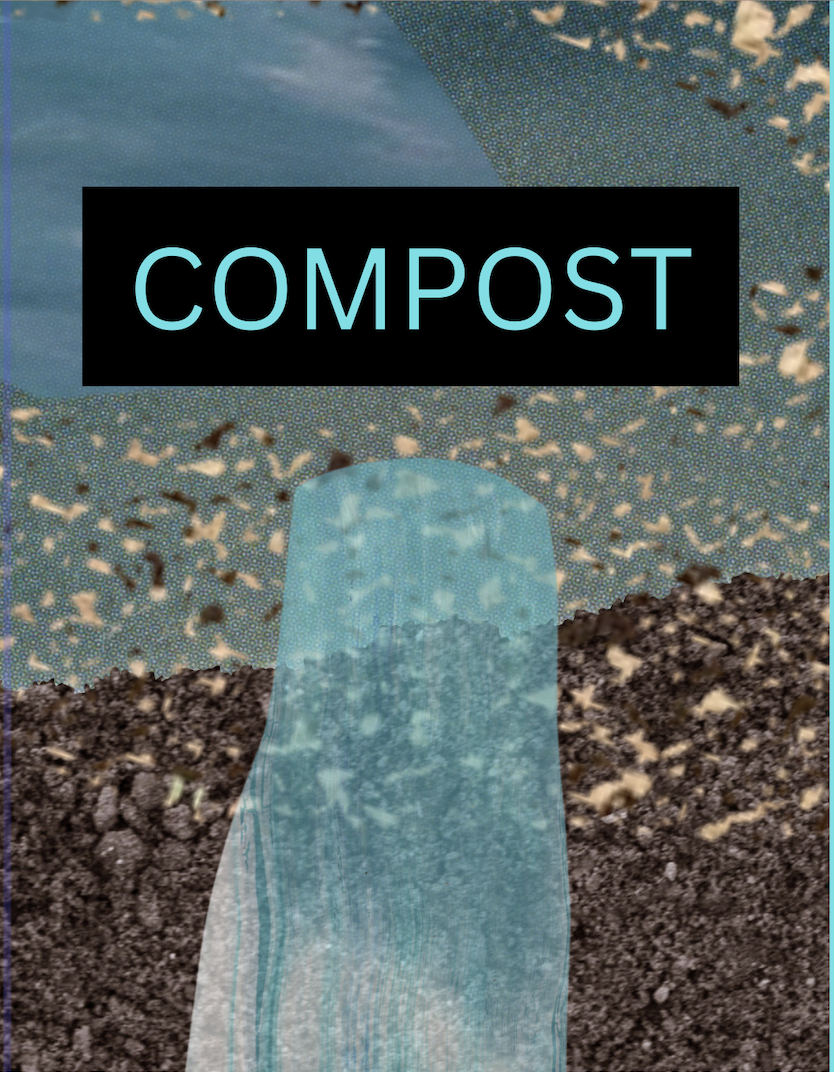
Why compost? We’ve been looking for slowness, and a possible transformation. We want to get a little bit more in touch with the dirt, and pay attention to how different things grow. We don’t need shiny new things, we just need other ways of working with what’s already here. Composting as a practice “implores that we attend to our critical metabolisms—to notice not only what is being transmogrified, but also under what conditions, why, and to what effect.”
We suppose this means that we don’t want to simply dump 5 years of Instagram posts into the compost bin and walk away; we want to tend what we’ve added, and turn it over carefully. We want to see what else might grow – a rogue cucumber here, or a deliberately reseeded garden there.
We are hoping for a transition that is also a decomposition that opens possibilities for unfurlings elsewhere.
Hamilton, J. & Neimanis, A. (2018) Composting Feminisms and Environmental Humanities. Environmental Humanities 10(2) 501-527. 10.1215/22011919-7156859
Citations curated by Julia Jung; Collage created by Manuela Rosso – Brugnach
 The FEELed lab