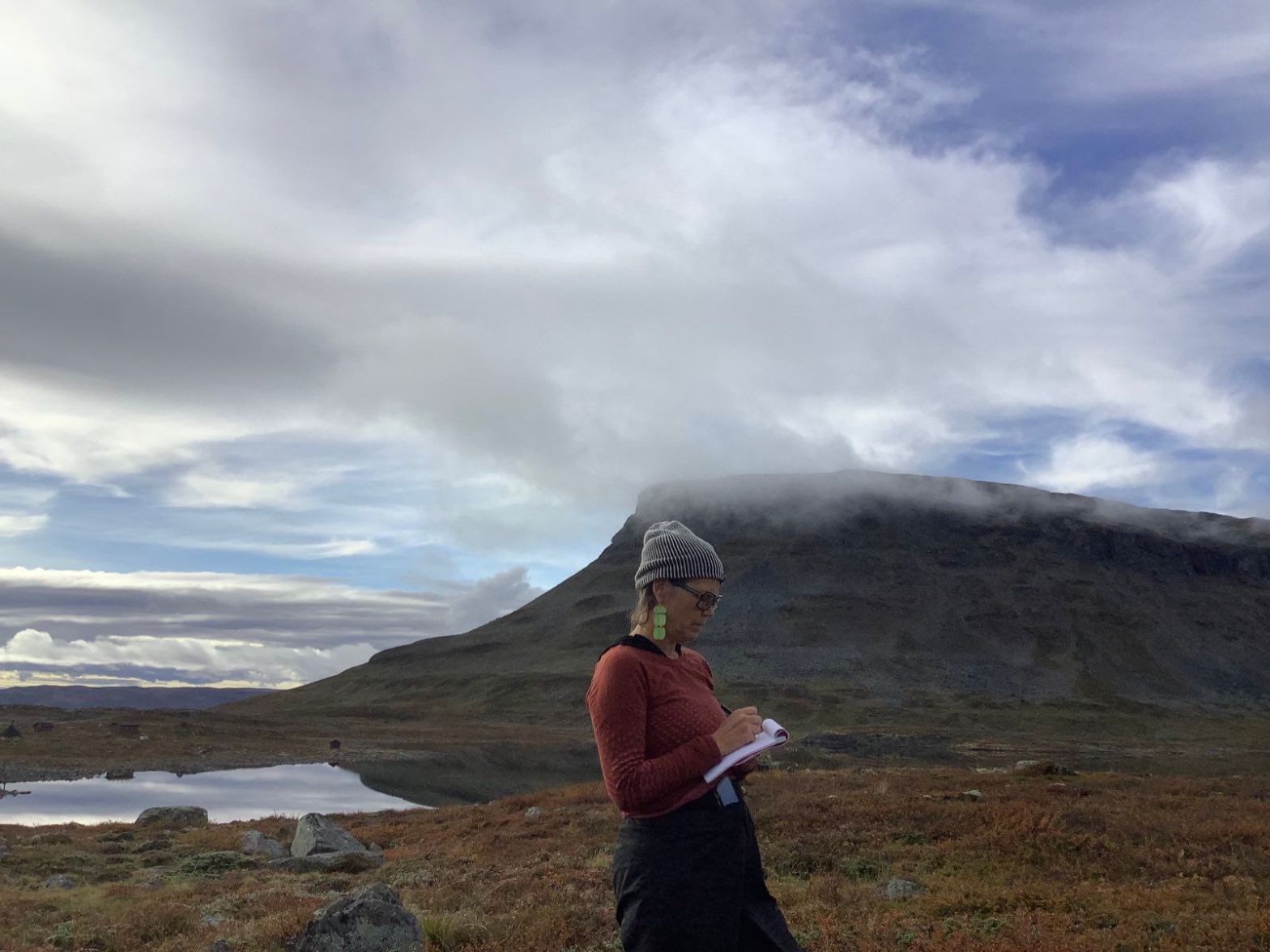
FEELed Lab Director Astrida Neimanis on visiting, living methodologies, and trying things out, at Field_Notes field laboratory in Sápmi in September 2025
The FEELed Lab is a project grounded in place: specifically, the unceded territories of the syilx people, and even more specifically – a small, thirsty place on those lands, adjacent to Bellevue Creek, beneath the Douglas firs and the red cedars, where deer and bears and baby raccoons sometimes visit us, too. All knowledge is grounded in place.
But FEELed work also travels. So when I visit other places to think and practice with others, I try to commit to being guided by two questions:
- How do I connect here to there? By this I mean: how do the lessons, tactics, methods, or protocols of one place move to another? What is familiar, and what is strange? How can learning in one place prepare me for being with another? What parts of place can be neither translated, nor prepared for? How might being attentive to this movement across (a kind of trans*ing, as explained by Eva Hayward[1]) help me learn things about both places, and my obligations to them?
- How can I be a good visitor? Visiting can be ‘overburdened by habits of touring, settlement, or occupation’ (as Eve Tuck and Karyn Recollet comment [2]); or it can be a ‘way of relating which has a slowness to it’ (in the words of Rebecca Beaulne-Stuebing [3]). I take instruction from Tania Willard and Leah Decter, who suggest “Firstly, you must know where are are at; you must know who you are, where you are, and how you got there.’ You need to ask about your ‘positions in Empire, both historically and in the present,’ and know what responsibilities ‘flow from these positions.’ Even if you carry struggles with you, know that ‘struggles ≠ innocence.’ As Willard and Decter put it: you must ‘take the highway out of your comfort zone.’ [4]
From September 14-24, I had the amazing opportunity to be part of Field_Notes 2025 “Living Methodologies” – a program organized by Bioart Society (Finland) of Finland and held in Sápmi – the cultural region of the Sámi people extending across Northern Finland, Sweden, Norway and Russia – at the Gilbbesjávri (Kilpisjärvi) Biological Research Station, and attended by a small group of artists (or art-adjacent practitioners, like me). As described by the Society:
Field_Notes deconstructs the concept of the traditional scientific laboratory in favour of research and knowledges that are situated and responsive to locales and contexts. Here the land and human/more-than-human ecosystems are not something to simply research in or about but research with.
It is difficult to find the right name for this kind of gathering – it was neither a workshop, nor a residency, nor a retreat, nor a seminar/conference – but it had elements of all of these. “Field laboratory” is the name that the Bioart Society uses, because both words capture something important about this gathering: it is ‘in the field,’ land-based, and away from any of the participants’ regular places of research, and it is based on principles of hypothesis and experimentation: we try things out, and see what we learn.
I was pretty excited when Yvonne Billimore, the Society’s current artistic director, extended an invitation to me to participate as a session leader in this year’s program; i had attended Field_Notes back in 2013 (it was only the second iteration of the program) when I was a baby academic, and it was life-changing for me. That time, I had the chance to work in a group with some incredible artists (Oron Catts, Kathy High, Kira O’Reilly, Antti Tenetz, Laura Beloff, Andy Gracie), who opened up for me entirely new methodologies that felt right for the kind of emplaced, embodied and experimental theory I was trying to produce. These days i call myself a practice-led theorist, and this shift in how i understand my practice was seeded back then.
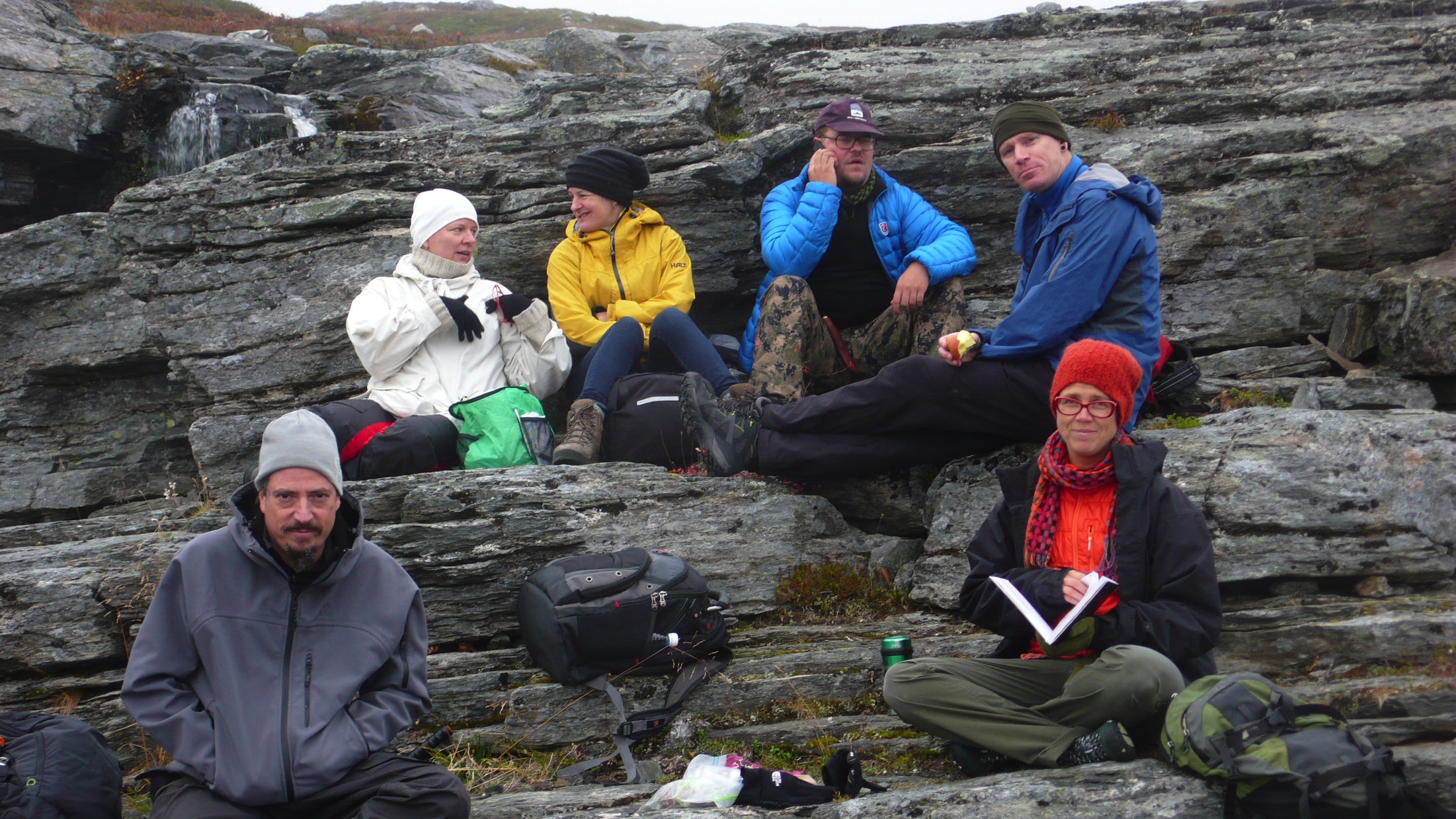
This time, many elements of Field_Notes were familiar (apart from my penchant for orange cold-weather wear LOL): working together with wildly interesting, curious and caring people (you can read more about them and their work here); experimenting with new methods and practices (e.g. soil chromatography, thanks to Sam Nightingale; or ‘reading together’ with (A) Alevtin); embracing how the mundanity and also joy of ‘down time’ and domestic activities (lichen incantations, tending the fire, picking berries, karaoke) become part of the learning, and part of the work.
But a lot has also changed since 2013 – personally for me, as well as in the world – and also at Field_Notes. This time, we paid a lot more attention to the non-fungibility of the place. What does it mean to gather on Sápmi, uninvited by the custodians of those lands, under the auspices of a (Western) scientific research station? These are real, material tensions that need to lead to changes in how we do research. We interfaced more this time with some of the scientists at the station, and had some difficult conversations. One of the highlights was an introduction to the ethical guidelines recently developed by a working group on research with the Sami people in Finland. Admittedly, I expected a box-ticking exercise. What we got was beautiful and personal storytelling from one of the field station employees, whose own family history is deeply tied up in these questions.
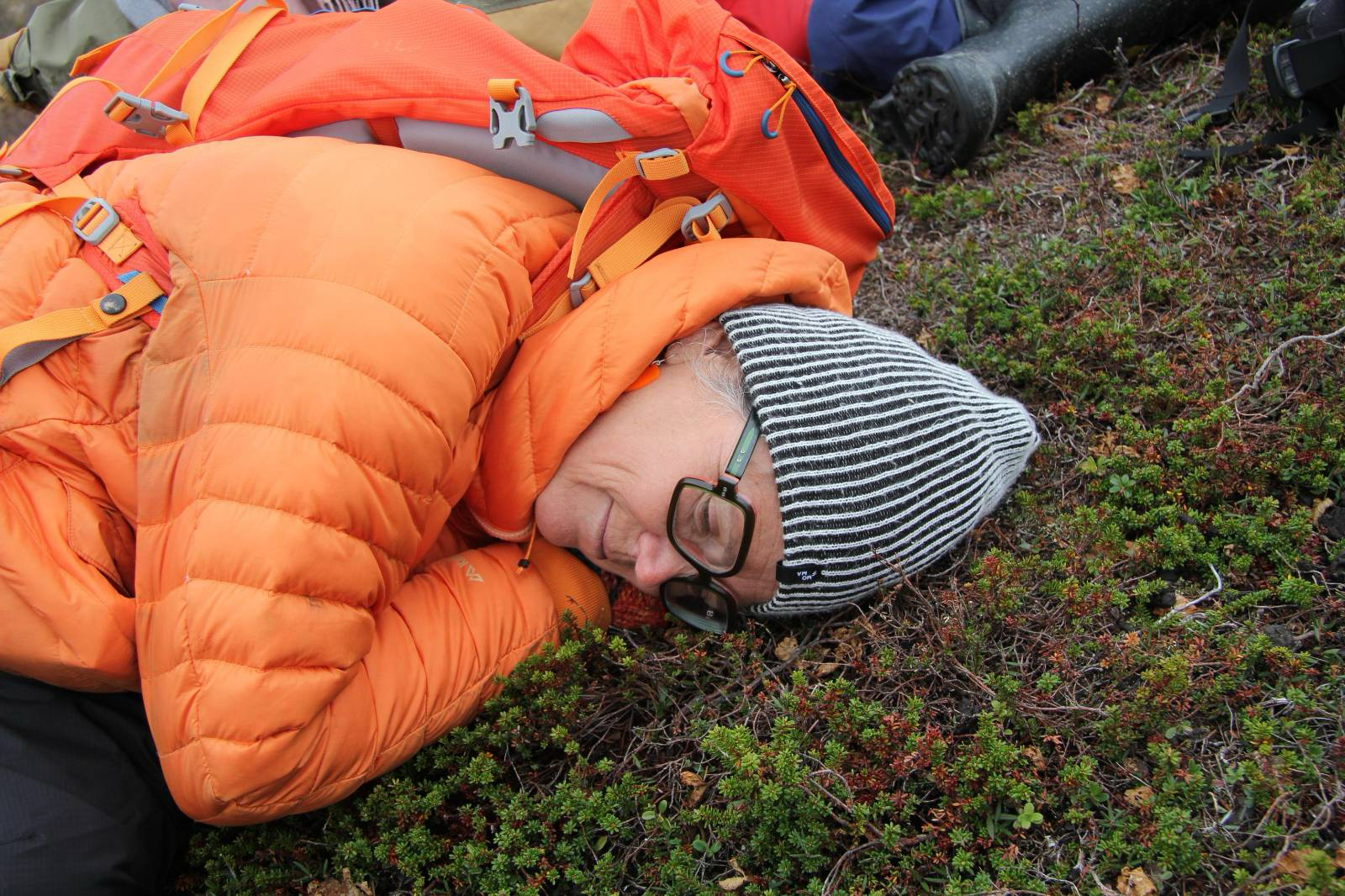
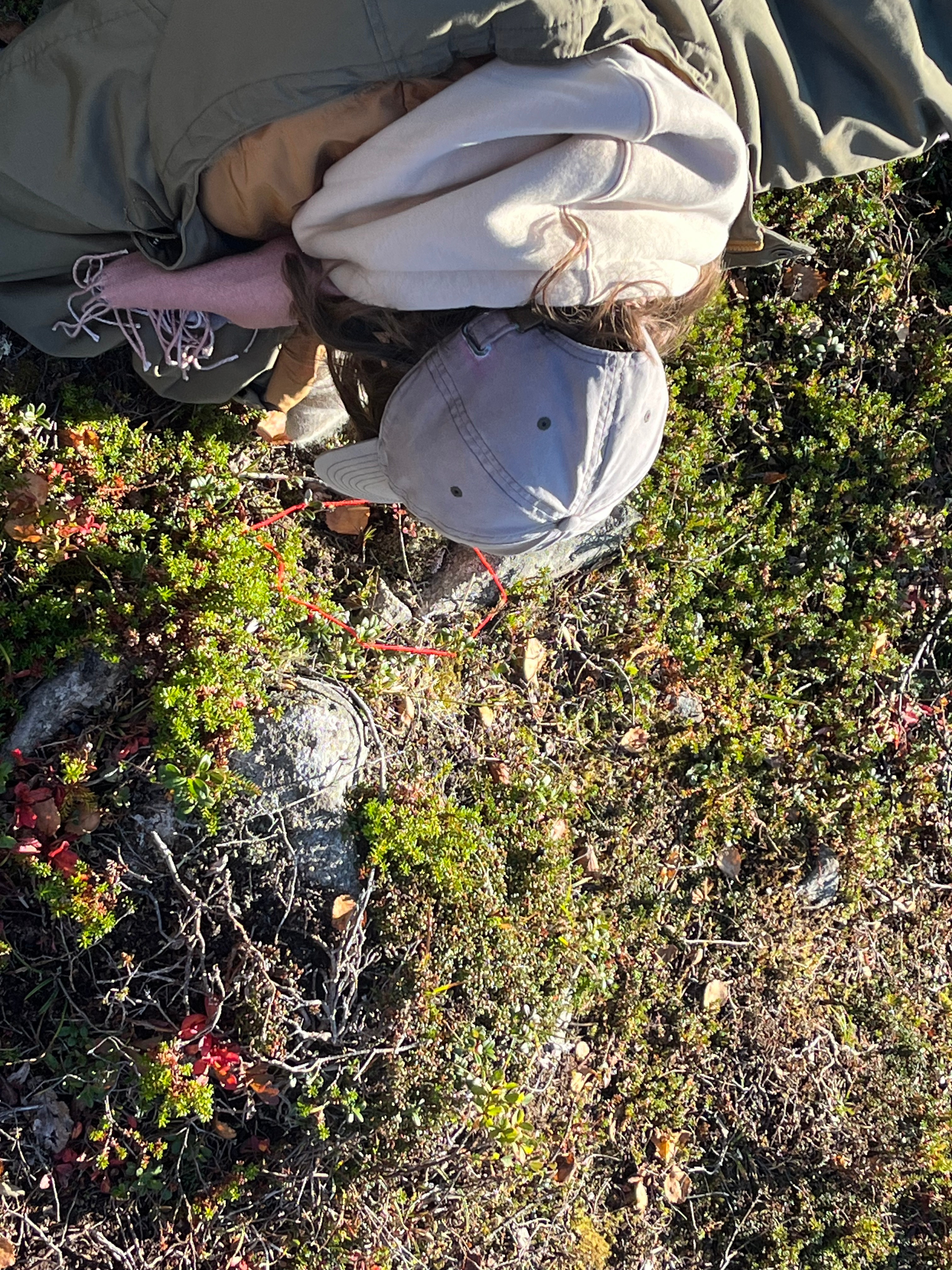
This time, our Field_Notes cohort also included a scientist – my sister, Aleksija, who is also my research collaborator. (We spoke about our work together on the Learning Endings project – you can listen to a recording of that talk here. We also invited creative play for developing protocols for our time together at Field_Notes ). I was also delighted to tell the group about the Earth Sense and Land as Teacher work of IndigenEYEZ that FEEled Lab has been able to support in the last two years, and offered a small variation on IndigenEYEZ’s classic activity “Seven Wonders of the World.” Instead of wonders, we asked participants to find seven forms of care within their small circles of red yarn, placed lightly on a tiny patch of subarctic tundra. This exercise had an intimacy that is hard to describe.
Having my sister Aleksija as part of our group also brought a different tenor and new insights to our work as artists/practitioners. What do artists and scientists have in common, and how does our care for the world, and for each other, manifest differently? What can we learn from each other?
For me, it was also another opportunity to reflect on the weird blur of personal and professional: while we are often told that living a good life means having clear separations between work and life (lest we emulate the workaholism demanded by the capitalist death drive!), lately I have also been curious about understanding my work as part of my lifework. How can work be but one of the places I experiment in articulating and aligning with values I am trying to live my life by (and still learning and cultivating)? In this sense, it is not a question of work taking over my life; it is life taking over my work. I’m into this.
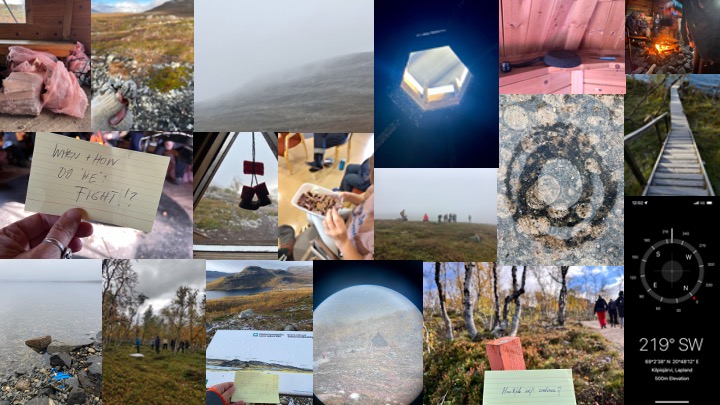
Many other questions surfaced, still to be explored:
- what is your field?
- what is ‘relevant’ research?
- how to you go gently?
- what will we let settle?
- how do we cultivate a radical openness (and is it desirable)?
- how do we attend to different kinds of boundaries (of our bodies, of the land) – especially as those boundaries may only be encountered when they are crossed?
- how can we make mistakes ethically?
- once we ‘take the highway out of our comfort zone’, how can we prepare for what comes next – as something which will always to some degree be impossible to know?
My primary research question for the past year has been: how do we build community across and through communities of difference, moving towards climate justice (or whatever we might call living well with each other and the earth)? Living Methodologies was another opportunity to experiment with answers.
References:
[1] Eva Hayward. “More Lessons from a Starfish: Prefixial Flesh and Transspeciated Selves.” WSQ: Women’s Studies Quarterly 36, no. 3–4 (2008): 64–85. https://doi.org/10.1353/wsq.0.0099.
[2] Karyn Recollet and Eve Tuck. Vistations (You are not alone). https://thefeeledlab.ca/wp-content/uploads/2025/11/39fdf-visitations28youarenotalone292017tuck26recollet.pdf
[3] Eve Tuck, Haliehana Stepetin, Rebecca Beaulne-Stuebing & Jo
Billows (2022): Visiting as an Indigenous feminist practice, Gender and Education, DOI: 10.1080/09540253.2022.2078796
[4] Tania Willard and Leah Decter, Directions to BUSH Gallery. C Magazine. https://cmagazine.com/articles/directions-to-bush-gallery
 The FEELed lab