This post was originally published by the Center for Climate Justice. You can view the original post here.
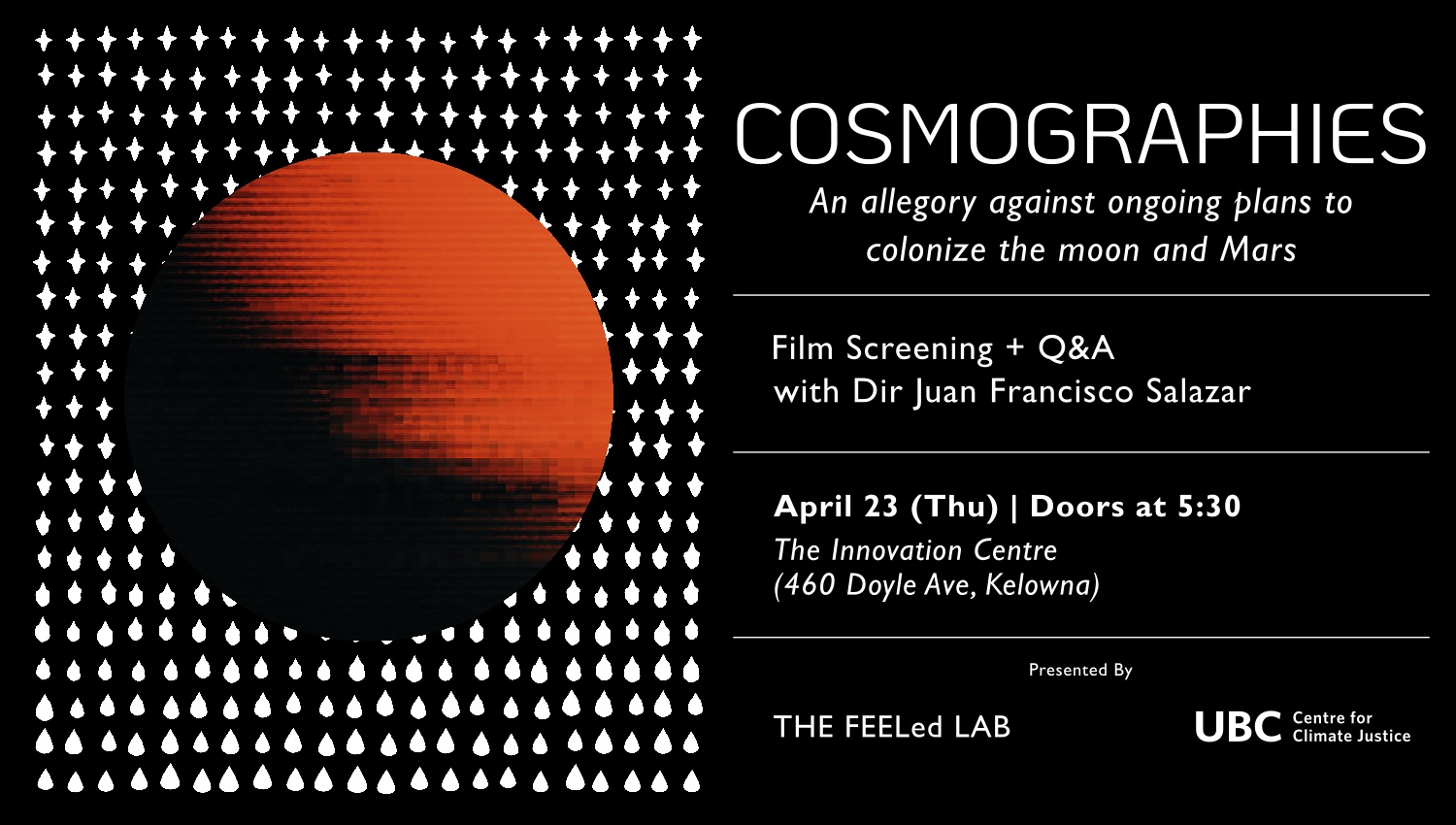
On April 23, the FEELed Lab and the Center for Climate Justice hosted a film screening of Juan Francisco Salazar’s latest film “Cosmographies” in Kelowna’s Innovation Center. The screening concluded with a Q&A with the director.
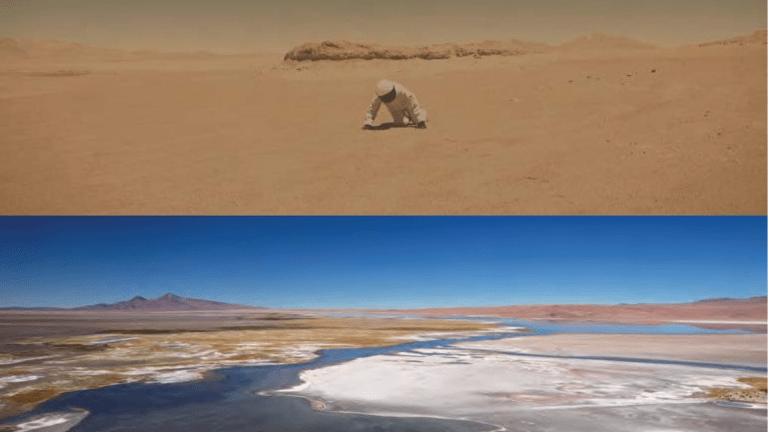
When the latest film from JF Salazar was described as a “speculative documentary,” it was hard to know what to expect…surely a documentary is based on fact? But through exploring what the current, fact-based, and devastating extractive activities being perpetrated in the Atacama Desert, the weaving of the past, present and future come together in a compelling and moving film that causes the viewer to examine more concretely where current practices might lead.
The film begins with a speculative future; an astronaut landing on Mars in 2050 to establish a settlement, who at once challenges the perception that Mars is a lifeless planet, describing it as “sentient.” Connections between the ways that different Indigenous peoples have similar relations with the solar system continue throughout the film, featuring people from across the southern hemisphere. The voiceover connects Māori conceptions of family, of connection, of relatives in the cosmos, before landing in the Atacama Desert where a member of the Atacameño-Lickanantay people speaks about the “galactic river of ancestors” with her grandchildren, and a Chilean geologist talks about the importance of the Desert for studying cosmic activity. She poignantly describes meteorites as “Rosetta stones” for understanding more about both the Earth and the solar system, an accurate but poetic way of conceiving these relationships. We see ancient rock drawings of flamingos, and farming practices that use ancestral innovations for conserving water where it is needed for agriculture. The priority for all of the Indigenous people featured is small impact, care, and respect for the ecosystems that surround and support their ways of life; under threat from the lithium mining expanding to provide much of the Western world with the minerals necessary for electrification.
Much of the film identifies instances of colonialism, both historic and present, in how extractive activities have wreaked damage and destruction on the precious ecosystems of the Atacama Desert. Significant water sites are included — rare in a Desert where some areas are so arid they have not seen water for millions of years — as well as a bay once teeming with ocean life where the infrastructure for transporting lithium to ships is now polluted and dead. The film highlights how the costs of this extraction for a ‘sustainable’ transition falls on the Atacama Desert, its peoples and its wildlife. Further speculation connects harvesting soil from the moon in 2032 with the activities on Earth, identifying them as “zones of sacrifice,” necessary for maintaining the progress of humanity, but towards what? And at what cost?
One final metaphor to draw out here, a rotifer zooplankton which exist in the Araucanian lakes of Southern Chile. This tiny animal adapts its asexual reproductive cycle to changing conditions from pollution and climate change, turning to sexual reproduction to produce eggs that can remain dormant for potentially hundreds or thousands of years until conditions are ideal again. The survival instinct of these microscopic creatures is miraculous, provoking the audience to consider not only what our own survival methods might be, but also what we are doing to these organisms to require them. As one of the participants describes “It’s not about studying; It’s about relating.”
Thank you so much to Juan Francisco Salazar for such a thought-provoking, important, and beautiful film, and for his considered answers in the Q&A that followed the screening. He closed with this sentiment: “I don’t pretend that the film will change anything but it can bring a spark of hope and bring people together.” The film has been screened at over 30 film festivals so far.
If you are looking to experience the film, Juan shared the link to watch it here:
This event was supported by UBC’s Centre for Climate Justice an the Pacific Institute for Climate Solutions (PICS).
 The FEELed lab