This FEELed Note was written by FEELed Lab research affiliates and climate solution scholars Jamie Stevens and Estraven Lupino-Smith whose project explores the potential of using arts‐led social infrastructures to address polarization for Anticolonial Climate Justice. We are grateful for feedback and revisions from FEELed Lab research administrator, Julia Jung.
In our previous FEELed Note, The Problem of Polarization, we mapped our understanding of polarization that emerged from our research over the year. By sharing our thoughts on this issue, we hoped to bring the problem back into the wider FEELed Lab community. At the same time as we were conducting our research, the socio-political context in BC experienced an intensification of polarization along existing cleavages centered on Indigenous Rights and Land Title. Specifically, there has been misinformation and the galvanizing of support around the Cowichan Decision, which is a landmark legal case that recognizes Cowichan Tribes title to the historic village site of Tl’uqtinus (Lulu island in Richmond) as well as an Aboriginal right to fish the south arm of the Fraser River1. Within this context, the flow of our research shifted to explicitly focus on:
- What are the drivers of these cleavages in BC?
- In response to the calls for material solidarity from Indigenous scholars, leaders, and communities, where does this project fit?
- How can we create a meaningful foundation for continued conversations around polarization and anti-colonial climate justice given the limited timeline of our project?
- How can we mobilize across difference, attempting to understand how polarization operates?
- How can we Connect Otherwise?
In February, these questions were spilling out into many everyday conversations for both Estraven and Jamie. Jamie brought these questions to her Indigenous Research Methods class with Dr Shawn Wilson during a discussion about Decolonizing Methodology (2022), by Linda Tuhiwai Smith. Jamie was wondering, “Are polarizing tendencies intrinsic to human societies, or are they an extension of what Tuhiwai Smith describes as the colonizer’s need of an Other to justify the colonial project? Colonialism is fed by binaries that sever and divide, so could the Us vs Them divide of polarization originate from the same foundational colonial logics?”
Dr. Wilson responded with a story about taking his students outside earlier in the day to find examples of how we have gendered nature. And then he drew red and blue scribbles on the board beside each other, with space between them – an oppositional binary. “This is western science’s perspective,” he said, “western science is obsessed with categorization that relies on making distinctions, but that eliminates context and interwoven relational realities.”
Dr. Wilson then drew red and blue scribbles right beside each other, overlapping and interwoven at the intersection, with dots of each colour also scattered through the other. “There are distinctions, but there’s a rainbow in between,” he said.
He pointed to the first drawing of separated colours, severed from each other, “this perceived binary and separation interrupts collaboration and erases nuance and context. And it’s false.”
He pointed back to the wiggly-lined-interwoven tapestry on the board, “this is reality. We are all connected.”
After Dr. Wilson finished speaking, other Indigenous students in the class added their insights which reiterated that humility and valuing the perspectives and truths of others were common values across their varied communities. Jamie remembers feeling a sense of both overwhelming gratitude and clarity. Gratitude because Jamie was the only settler-scholar in the class and everyone was generously sharing their stories to help her understand. Clarity because the colonial logics that she was unlearning were so entrenched that while she knew something was off in the normative polarization research, it was not until this moment that she could articulate that it was the foundational framing that was the problem. While there is a danger of settler-academics lumping all Indigenous Knowledges together into some bland, pan-Indigenous, mush – this exchange was about individuals sharing their specific stories and frameworks for being. The teachings echoed across the literature we had been reading about climate justice and anti-colonial action.
This evokes ecofeminist scholar Val Plumwood’s master model of the dualist logic of colonialism. She theorizes that Western thought (long before modernity) is founded on dualistic, hierarchical splits, such as man/woman, culture/nature, reason/emotion, which privileges one of the pair over the other. Most importantly for this discussion, there is a split between self/other, which produces the Us vs. Them perception that allows polarizing narratives to flourish.
Dr. Wilson’s teaching in this class also echoes in his work on relational accountability – the idea that any project should be mutually beneficial to those involved2. This is a key part of anti-colonial climate justice, and an antidote to polarization because the fundamental tenet suggests that climate action must be mutually beneficial to all involved, including the non-human world. This approach is echoed though repeated calls to action from Indigenous leaders and communities. For example, in 2017 an International Summit on Climate Change was initiated by the Turtle Lodge and hosted by the Sagkeen First Nation in Manitoba. The Summit centered on bringing Indigenous knowledge of living in balance with nature’s laws together with contributions from international climate leaders.
The summit produced calls to action focusing on four themes: ancestral knowledge, sovereignty, relationships, and transformation. In their paper discussing the conference, Cameron et al (2021) highlight that in stark contrast to the framing of climate change as an issue of the environment, or one that can be addressed through technical and technological intervention, the Elders contended that it is principally social change that is needed, through what they named ‘a change of the heart’. This change of heart is a necessary part of relational accountability. In order to build coalitions for climate justice more is needed than just a shift in political analysis – a foundational perception of relation is necessary.
When we discussed Dr. Wilson’s teachings with Astrida, she reflected that “maybe the gender binary and polarization are the same – they’re perceptions, they’re not ‘real’ but they are real in their effects.” This clarified a sticking point in the research – countering polarization was not about finding common ground (how do you find common ground in unjust power binaries?), but resisting binary frameworks that force simplistic answers. Since colonization thrives on binaries, anti-colonial research requires relentless attention to interconnection, contextual nuance, and relationality. Therefore, transformative climate action requires not only better research and policies, but an intersectional understanding of climate injustice.
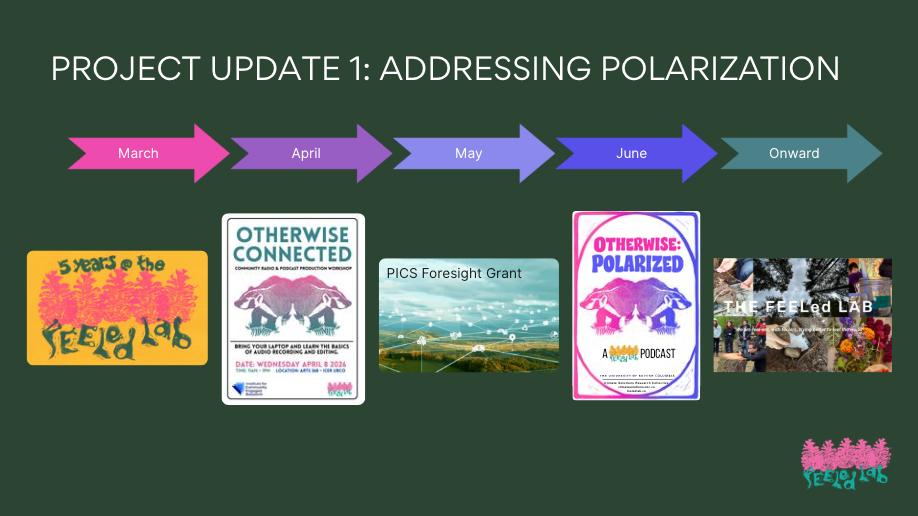
As a research team, we discussed our roles as settler-scholar-practitioners in heart-work, and how we could bolster settler support and participation in what Simpson (2024) has named the constellation of co-resistance. Her work calls for localized, collective networks where Indigenous, Black, and other marginalized communities build ethical futures together instead of appealing to the settler-colonial state. Part of pursuing this for our team was to apply for a Pacific Institute For Climate Solutions grant to bring together researchers and practitioners in dialogue, while supporting the mobilization of resources towards broader solidarity and transformations of the heart.
In doing so, we sought to amplify and enact what Jeannette Armstrong, Naomi Klein and Onyx Sloan Morgan discussed in 2024, stating that to build meaningful relationships can transform coalition building because anti-colonial climate justice requires transformative approaches to collaboration as well as transformational relationships with land3. The format of our proposed dialogue hopes to model this. We want to strengthen justice- and coalition-based actions and relationships that are rooted in place, guided by the legal authorities of the syilx nation on whose territories we hope to gather. The dialogue is an intersectional feminist infrastructure, working alongside and in coalitional relationality with syilx- and Indigenous colleagues to foreground climate justice. By foregrounding social infrastructures we hope engage in relational accountability and directly contradict the many climate mitigation infrastructural projects that primarily fortify the status quo of Western land management and neoliberal resilience4. Our hope is that these social infrastructures will offer transformative relations to land and each other5, and can undo the harms of colonial binaries that produce and perpetuate polarizing tendencies.
References:
Cameron, L., Courchene, D., Ijaz, S., & Mauro, I. (2021). ‘A change of heart’: Indigenous perspectives from the Onjisay Aki Summit on climate change. Climatic change, 164(3), 43. https://doi.org/10.1007/s10584-021-03000-8
Gaard, G. (2001). Women, water, energy: An ecofeminist approach. Organization & Environment, 14(2), 157–172. https://www.jstor.org/stable/26161568
1 For more on the Cowichan Decision, see: https://news.ubc.ca/2026/02/cowichan-decision-wont-affect-private-landowners/ and https://www.firstpeopleslaw.com/public-education/blog/correcting-misconceptions-the-cowichan-tribes-decision
2 Wilson, S. (2008). Research Is Ceremony: Indigenous Research Methods. Nova Scotia: Fernwood Publishing.
3 Jeannette Armstrong, Naomi Klein, and Onyx Sloan Morgan. “Syilx-Led Climate Justice in a Global Context.” Preprint, ICER Press, 2024. https://doi.org/10.14288/FT1K-G107; Janna Wale. “What Does Reconciliation Look like in an Era of Climate Turmoil?” Pacific Institute for Climate Solutions, 2025. https://climatesolutions.ca/reflections/what-does-reconciliation-look-like-in-an-era-of-climate-turmoil/.
4 Juan Francisco Salazar, “Cosmographies.” (2025); Juan Francisco Salazar, and Katherine Gibson. “The bamboo bridge.” (2019).
5 Sarah Hunt/Tłaliłila’ogwa. “(Re)Making Native Space: Locating Gendered Geographies of Law, Territoriality, and Dispossession in the Colonial Archive.” Annals of the American Association of Geographers 115, no. 9 (2025): 2134–48. https://doi.org/10.1080/24694452.2025.2510701; Astrida Neimanis and Jennifer Mae Hamilton. How to Weather Together: Feminist Practice for Climate Change. Bloomsbury Publishing, 2026.


1 comment