This FEELed Note was written by Samantha Jones, who was a visiting artist and researcher at the FEELed Lab in September 2026.
In September 2026, I spent a week as a visiting researcher at the FEELed Lab, University of British Columbia Okanagan, in Kelowna. Some of my visit was dedicated to a writing workshop as part of my postdoctoral research with the Health Arts Research Centre, University of Northern British Columbia.
My project, Poetic Forecasts, aims to use poetry as a method to connect weather and climate with lived experiences of wellness, and to examine emergent themes in the context of regional climate change trends. My intentions as a visiting researcher at the FEELed Lab also prioritized time for research-creation, deep thinking, and reflection while learning from the ecosystems as a guest on unceded Syilx territory.
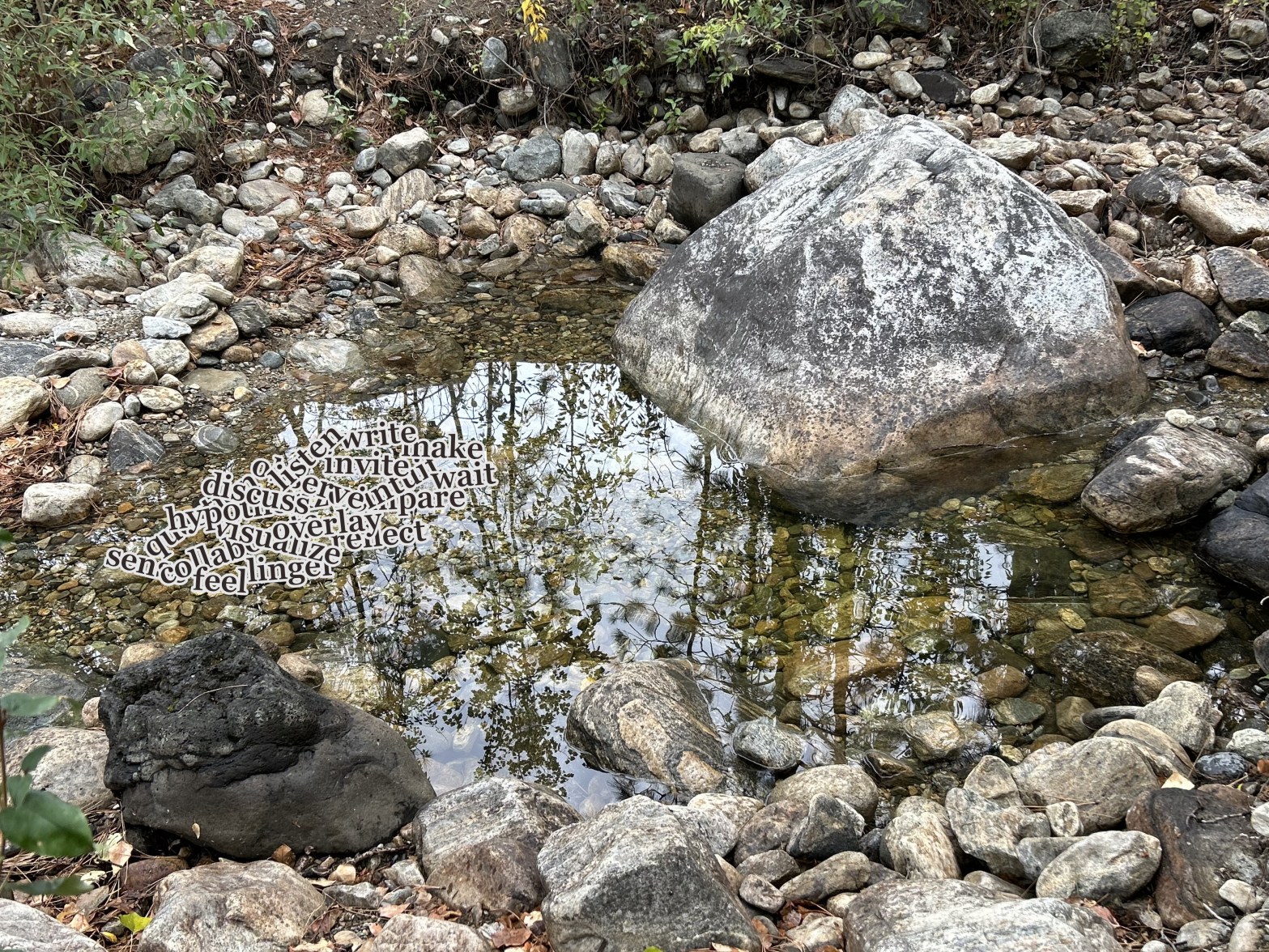
Bellevue Creek is steps away from the FEELed Lab, and one morning I followed the Bellevue Creek Greenway back and forth to a cafe in Mission. The parts of the creek that I walked featured shallow, rocky sections called riffles and cascade reaches where water moves downstream through a series of pools (see ECOSCAPE Environmental Consultants, 2006). The large boulders and mirror-like pools were attention grabbing, and I sat with a hot coffee, notebook, and my phone camera on the bank near a pool a few meters in diameter.
The downstream margin of the pool was mantled by a dam of ponderosa pine needles, twigs, leaf litter, conifer cones, and other organics entangled with streambed cobbles. Much of these materials sat above the current water level, evidence they were carried to this location in higher waters. Some of this material will continue its journey downstream when the channel fills with water again. But for now, this assemblage will experience a stillness as individual parts and as a greater, collective structure.
What uncommon assemblages might grow in and around a pool with time and rest?
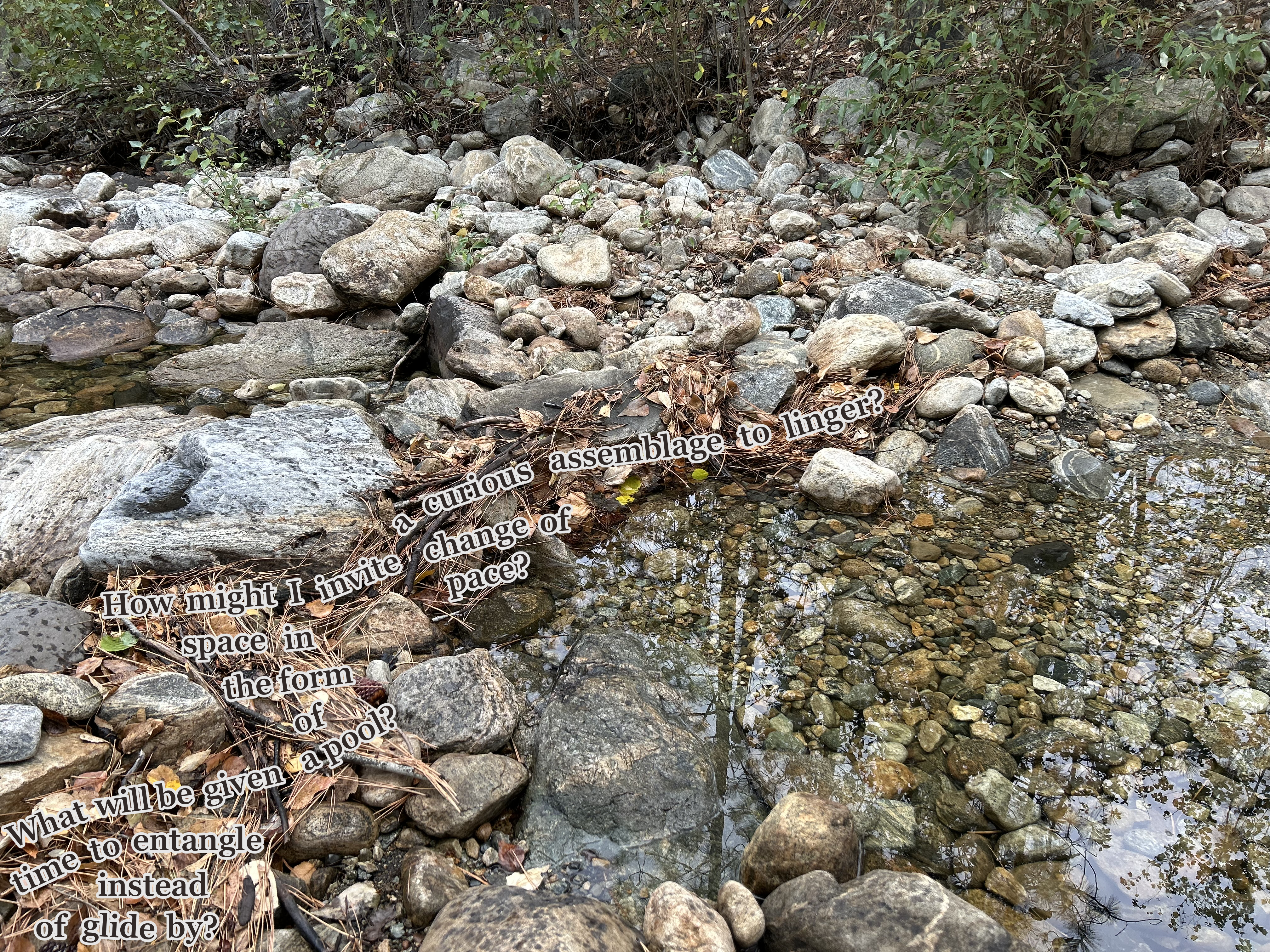
The “boulder-pool complexes” (ECOSCAPE Environmental Consultants, 2006, Figure 3) observed in Bellevue Creek are important fish habitat (ECOSCAPE Environmental Consultants, 2006) and in periods of low streamflow, like the conditions during my September visit, pools dot the channel like pearls threaded by narrow stretches of the creek. In seasons where the creek is a trickle and the water movement through the pools is almost imperceivable to the human eye, sediments and other materials have opportunity to rest.
What unsorted bounty of ways of understanding can settle together in the wake of a churning up?
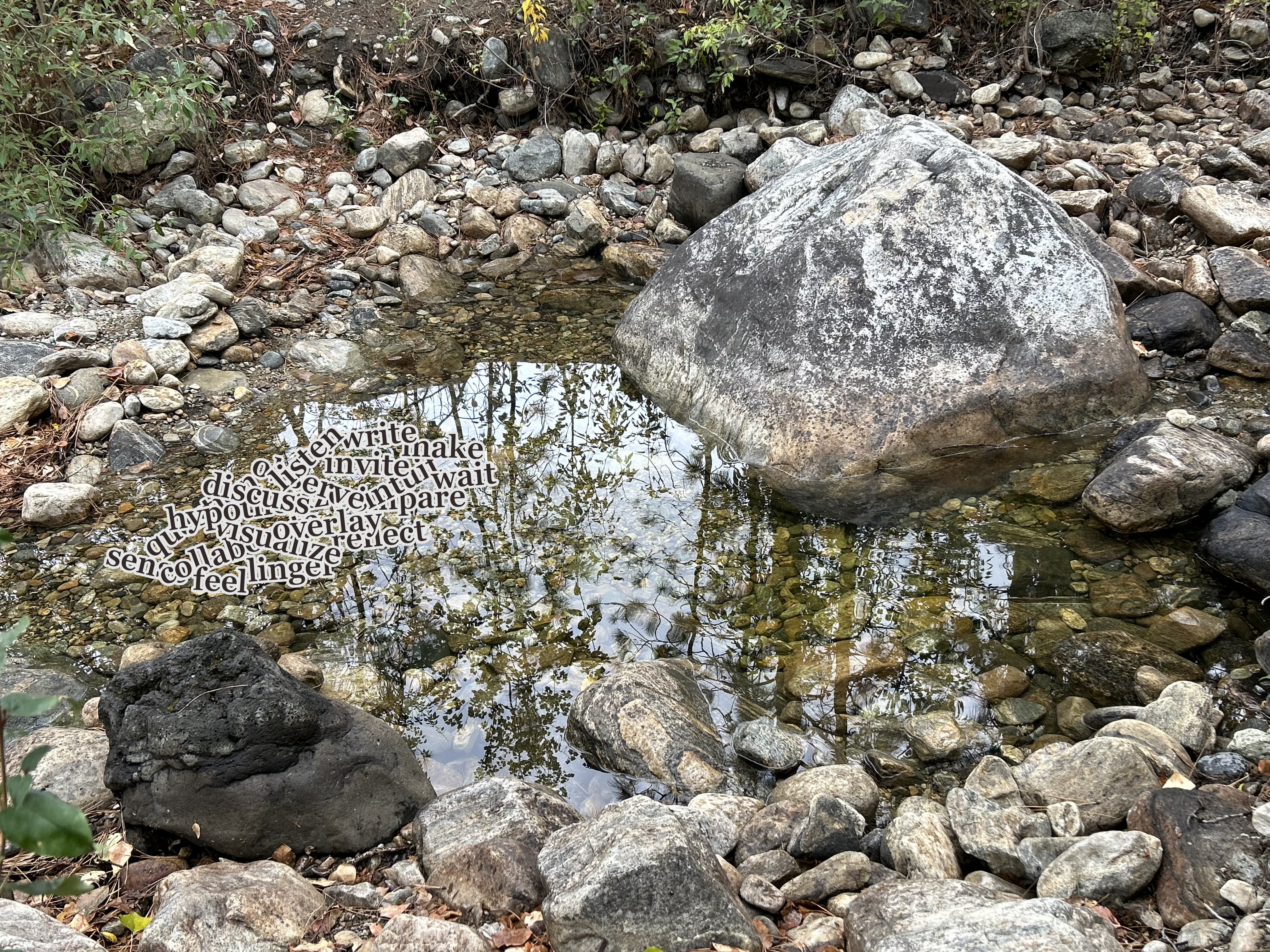
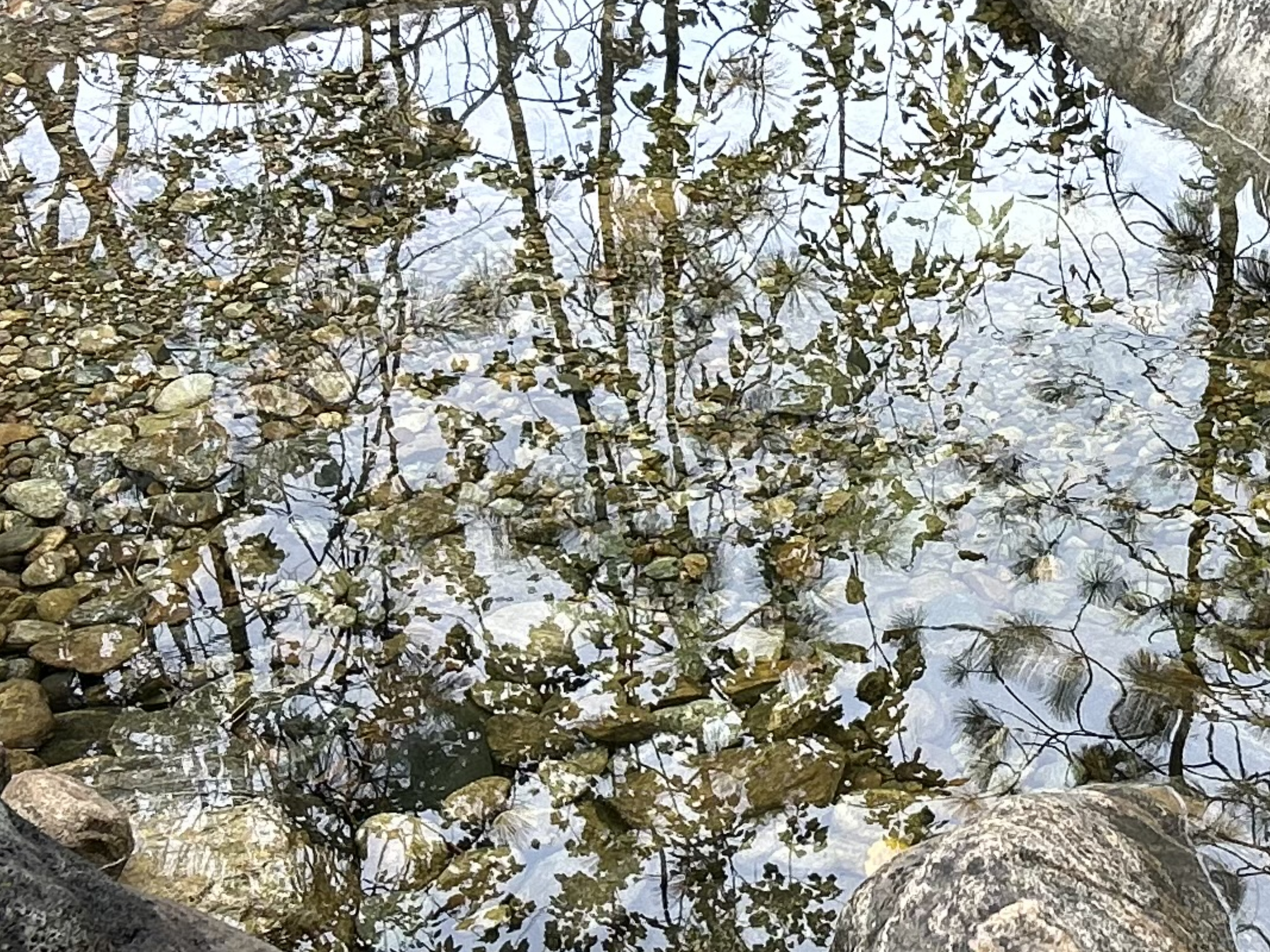
The relative stillness in the pool makes it possible to simultaneously view the rocks and sediments of the streambed and the overlaid reflections of vegetation and the skies above. The pool invites multiple spheres to be perceived together and although I look down at the water and the earth, the pool reminds me that what I am observing is only part of a larger, interconnected system.
How can stillness remind me that the subject of my interest exists within a larger context?
Perhaps the trajectory of a research project, or scholarly career, can be crafted like a cascade with stretches of high energy intentionally punctuated by relatively still and reflective pools. This could involve creating new pools as well as noticing pools by other names that already exist within one’s scholarship and protecting time to linger there. This may require shifts in attitudes and expectations, particularly in disciplines where methods are often described as idealized or linear workflows.
In their chapter on creative methods in geography, Barbarossa et al. (2023, 305) explain that researchers should be able to articulate the unique contributions a creative method brings to their research; they ask, “How does it reorient our lines of enquiry and how we know the problem?” Perhaps an antidote to hesitations around creating and residing within pools requires recognition that this practice is a research method—it invokes conditions favorable for organic transdisciplinary entanglements to develop from vast and varied knowledges.
Suggestions for creating pools within research:
- Reserve time for exploration and play without commitment to deliverables. Recognize this work as a method and valued scholarly practice.
- Bring together books, articles, maps, photographs, art, recordings, objects, and anything that inspires you. Place them beside each other. Bring them into conversation with one another. How do they push and pull? How do they work together? How do they do different things?
- Enable others to create pools. This could include unscripted time in a graduate seminar or supporting colleagues to prioritize the stillness required to recognize or craft unlikely entanglements.
- Identify activities within your research that are already periods of messy creativity, brainstorming, exploratory learning, and reflecting. Prioritize and expand these periods with attention to the slowness needed to develop them into pools.
References
Barbarossa, E., Chambliss, W., Hawkins, H., and Jamieson, W. 2023. GeoHumanities and Creative Research Methods. In Clifford, N., Cope, M. and Gillespie, T. W., eds. Key methods in geography, fourth edition. 301–319.
ECOSCAPE Environmental Consultants. 2006. Sensitive habitat inventory and mapping (SHIM), Volume 1. Mill Creek and Bellevue Creek, Kelowna, British Columbia. https://a100.gov.bc.ca/pub/acat/public/viewReport.do?reportId=23769
Acknowledgements
Poetic Forecasts is a SSHRC Banting Postdoctoral Fellowship that also receives support from the University of Northern British Columbia and Canadian Institutes of Health Research through my supervisor, Dr. Sarah de Leeuw. Thank you to Dr. Astrida Neimanis, Julia Jung, and the FEELed Lab for hosting me and allowing me to hold a research workshop at the beautiful Woodhaven Ecoculture Centre. Gratitude to Friends of Woodhaven, Poetic Forecasts workshop participants (in Kelowna and across the entire project), and local businesses and venues who allowed me to advertise in their spaces.

