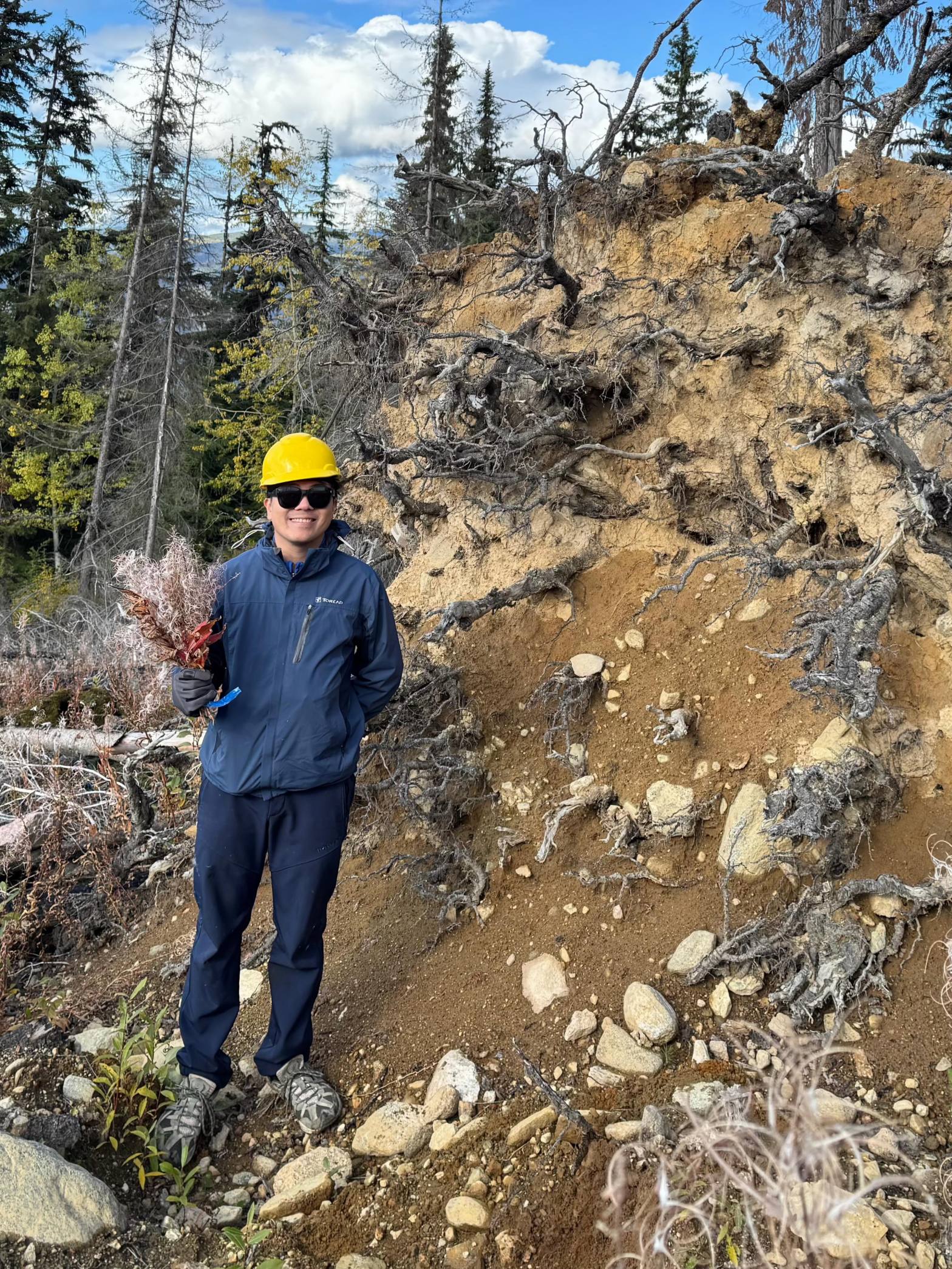
As we welcome new people to the FEELed Lab, we want to make space for longer introductions to project team members and research affiliates joining us this year. This profile is on Ming Qiu, who is joining us as a research affiliate on our new project “Untapping Watershed Relations: Water in Woodhaven”.
- Can you tell us about your work/research?
My research sits at the intersection of ecohydrology and landscape ecology, exploring how the spatial patterns of forests shape how water moves through a landscape. Trained initially in landscape architecture before transitioning into forest hydrology for my PhD at UBCO, I have always been fascinated by landscape patterns—how different patches, like forests and grasslands, are spatially arranged, and how their shapes and sizes interact. With my interdisciplinary background, I wanted to bring this spatial lens into forest hydrology, where traditional management and stewardship have historically focused almost exclusively on total forest cover.
To understand the ecohydrological role of landscape patterns, I look closely at forest edges—the transitional zones where forest meets clearing. Here, edge trees are exposed to heightened environmental stressors, such as intense solar radiation and drier microclimates. My research shows that the hydrological impacts of forest patterns are largely driven by these edge effects: when a landscape has a higher density of edges, more trees experience microclimatic stress, which ripples outward into broader hydrological responses.
This finding opens up a novel pathway for watershed management, particularly in regions where forestry remains a vital economic pillar. Rather than looking only at how much forest is harvested, proactive spatial planning allows us to consider how harvesting is arranged on the land to buffer adverse hydrological impacts—a perspective that feels especially urgent as human disturbances increasingly reshape our forests.
2. Why did you want to work with the FEELed Lab?
Working with the FEELed Lab feels like a natural—and much-needed—homecoming for the different parts of my background. In moving from landscape architecture into quantitative environmental science, I have always felt like I was traveling between art and science. Landscape design trained my eye for aesthetics, form, and human experience, whereas environmental science asks me to stay grounded in rigorous logic and quantitative analysis. The FEELed Lab feels like a space where I don’t have to choose between the two—I can finally bring them together.
3. Why are expansive engagements with environmental issues important?
Because we live within the environment—it is the physical form that provides us with shelter and food. To engage expansively with environmental issues essentially means our practicing care and taking on responsibility. Ultimately, the return on fulfilling that responsibility is the guarantee of our own safety and collective future.
4. What are you most excited about regarding our water in woodhaven project?
I am so excited for the collaborative spirit of this project. In my day-to-day work, I am mostly surrounded by fellow scientists, and we are used to speaking through data, models, and numbers. While data is essential, it can also feel cold—it is, after all, a heavy abstraction of a rich and living world. Working alongside an interdisciplinary cohort of artists and humanists opens up a completely different lens: one grounded in lived feelings, sensory connection, and warmth. I am really looking forward to co-learning with the team and discovering the kind of creative chemistry that happens when the arts and sciences truly enter conversation with each other.

