
What a year! It is amazing to think that 18 months ago, the FEELed Lab was just finding its feet – stretching out a few toes across the grass to test whether it could find its footing, and whether there would be anyone else in the field (FEELed) who wanted to join in.
Fast forward, and we have just wrapped up a busy and bountiful year of events, connections, partnerships, visitors, reflections, meals (!), feeled trips, and more.
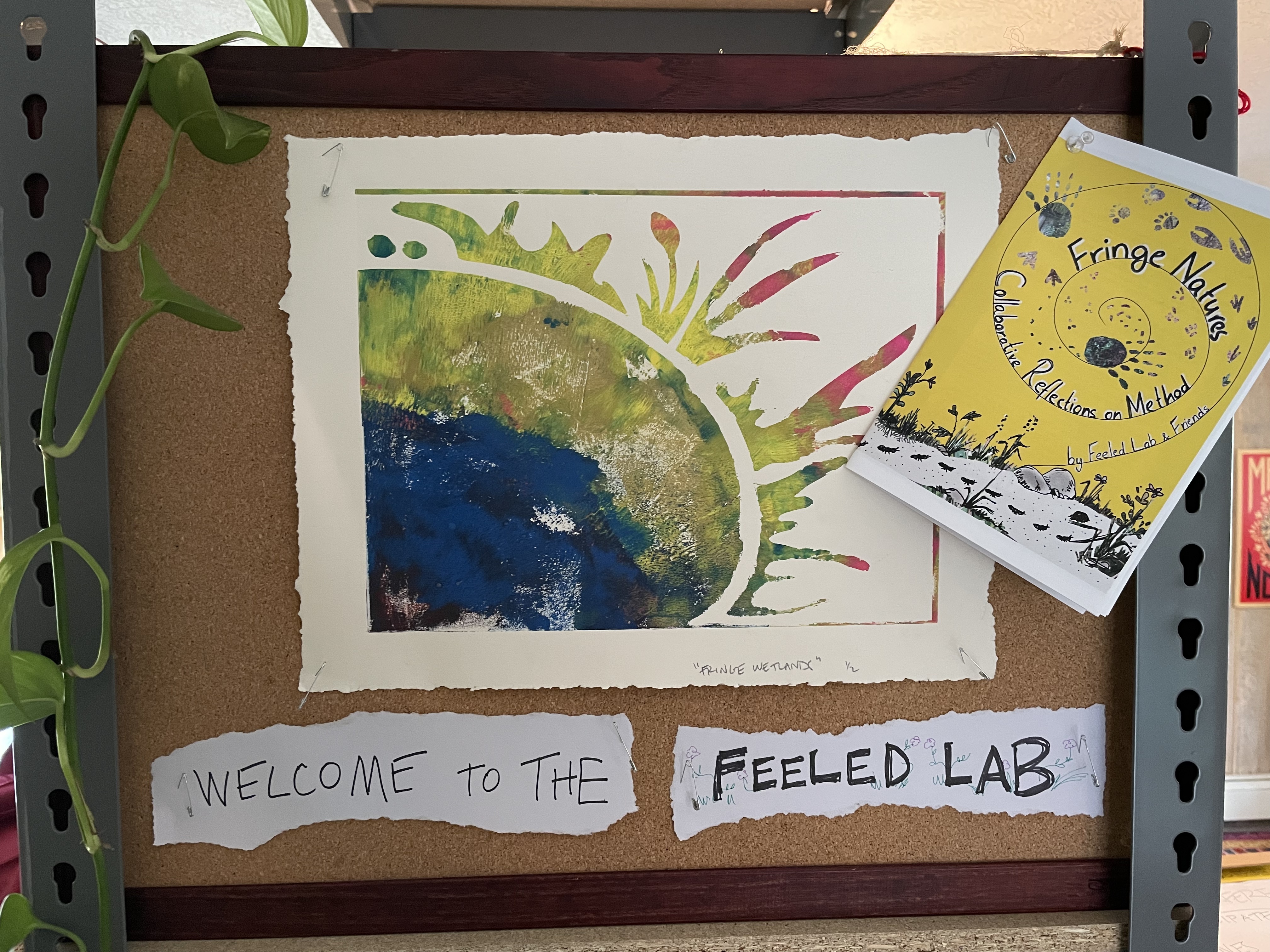
When I (Astrida) started manifesting the lab (alongside Madi Donald and Dani Pierson, who have been part of the feeled since the very beginning), a colleague asked me how soon we planned to “scale up”: Would we apply for a major infrastructure grant? How fast would we move to become a formalized research “Centre”? What about applying for a Centre of Excellence grant?
Just writing that sentence (and recounting that conversation) feels overwhelming; I can’t imagine how it would feel to commit to the labour it demands. There is immense pressure in academia to always move towards something bigger/more/(not-necessarily-)better. We are encouraged to “stake our territory”, “brand” our concepts, and measure our “impact” where getting bigger is always perceived as desirable. (I actually wrote about this pressure/mindset about a decade ago, in a beautiful collection edited by Rita Wong and Dorothy Christian called Downstream.)
I don’t believe that the kind of work that we do at the FEELed Lab will get better by being bigger. It certainly won’t get better by moving faster. We want to cultivate relationships with each other and this place, and that takes time. It takes a certain kind of patience, and vulnerability, and intimacy. If anything, we want to slow down even more! Sustainability is a complex ecology of labours, bodies, feelings, places, energies, and more. We can’t support sustainability without sustaining our contexts and ourselves.
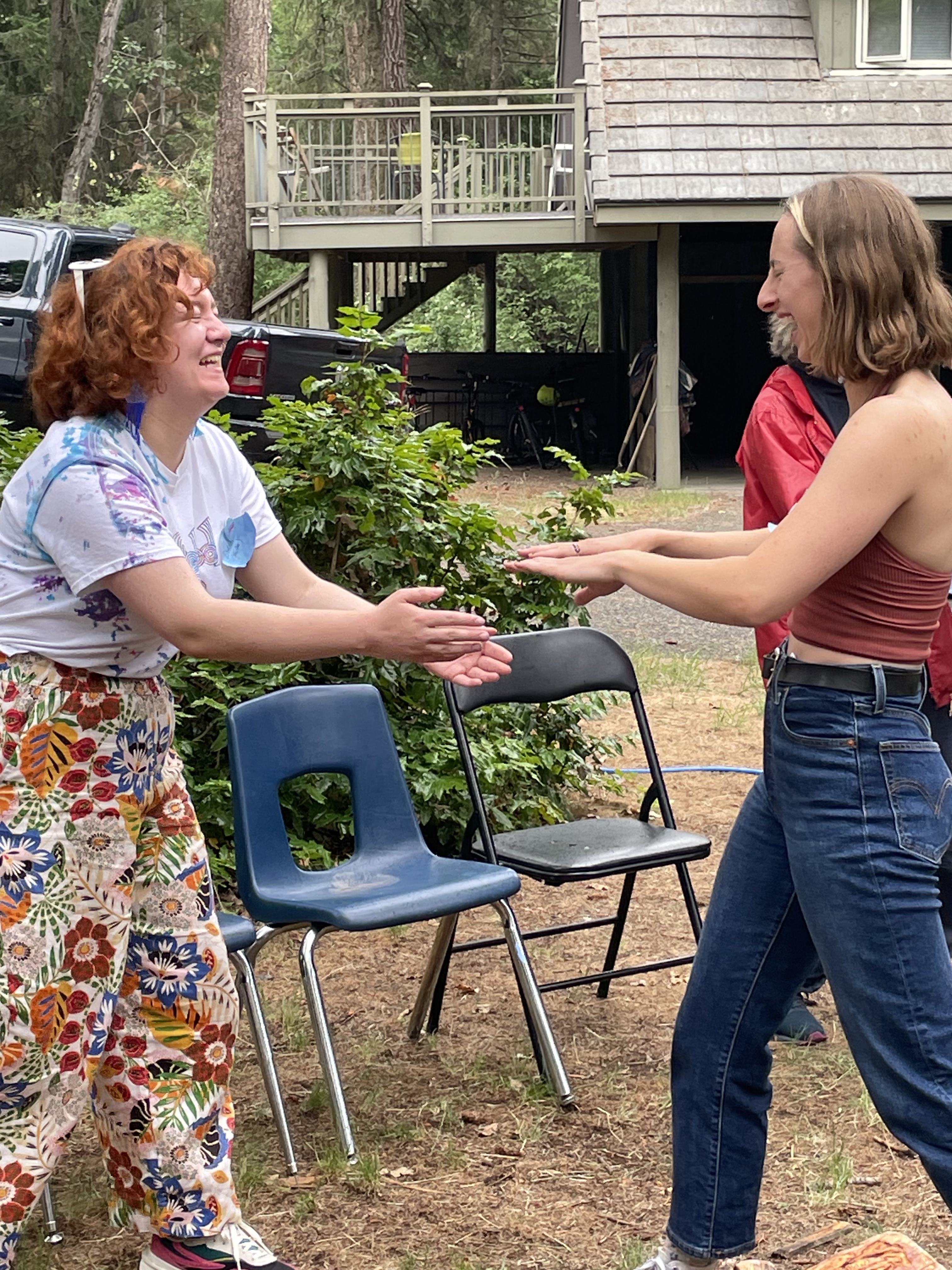
The past 10 months have been an experiment in trying out ways to do this. Our work has included (grab a coffee, this might take a while!):
- Co-producing a zine with FEELed Lab researchers and friends, as part of a low-carbon methods research conference, and featured at our welcome back breakfast last September (when i want to think about our collectively articulated values and commitments, i often return to this zine – check it out!)
- Five Littoral Listening sessions, each convened by an Associate Researcher who brought their own interests and ideas to this accessible on-line space for reading out loud together and discussing what comes up
- Three Fringe Natures workshops on cyanotype printing with natural pigments, queer eco-gothic portraiture in the woods organized by Associate Researcher Tara Nicholson and rest as resistance, organized by our Lab Administrator and MA student Dani Pierson. Both were convened onsite at the FEELed Lab as a way of coming to understand our relationship to this place better. (We should also mention the amazing Fringe Natures “Lichen Love” workshop last summer, with visiting artist Tessa Zettel!)
- Making space for student, faculty and guest researchers to work, gather, share food and conversation, since the circumstances in which we write/think/work influence what it is we make in no small way! (If you are interested in working at the FEELed Lab during the 2023/24 academic year, please look at our “Collaborate and Get Involved” tab)
- Hosting three international Visiting Researchers (Therese Keogh from the University of Melbourne; Jennifer Hamilton from UNE in Armidale, Australia; and Rebecca Macklin from the University of Edinburgh). Thanks to all three for their featured talks and participation in our on-campus events, too!
- In January, we welcomed artist-performer Hanna Sybille Mueller, who offered us a “Liquid Bodies” dance/movement workshop on a cold, dark January evening, around the firepit. What an experience!
- Therese also convened the Written Together writing group, and has maintained relations with many of the researchers she met her, including offering guest lectures in their UBCO classes.
- Therese, Rebecca and I also undertook a transformative “FEELed trip” to the Tar Sands, which you can read about here.
- Under Rebecca and Dani’s enthusiastic influence, we also launched our “Craft-a-strophe!” series, where we make/craft and read poetry together as a way of processing catastrophe (all of the many ways that you understand that sentence could be relevant). We convened two sessions at the FEELed Lab, and a third emergency button-making session on campus at the AMP Lab; we are planning more for next year! (Do you have any great ideas? Share them with us please!)
- Natalie Rice was with the FEELed Lab this year as our “Researcher of/in/with Place.” She inaugurated our library project and convened two events: at the first we buried a book of poetry by Norah Bowman (who joined us for the internment), and at the second we unearthed it. These events were experiments in thinking about how the earth reads and writes too, as part of the more expansive “library” that includes the Land at Woodhaven. We also recommend checking out Natalie’s blog series (and her new book of poetry)!
- As part of an ALT-2040-funded project on teaching and learning, Natalie Forssman, Daisy Pullman, Haida Gaede and I convened several workshops with access and inclusion experts and community members to think about how place-based teaching can be more accessible and inclusive, in the broadest sense of this term. We presented this work at the UBC Celebrate Teaching! events in May. Thanks as well to researchers Madi Donald and Emilie Ovenden, who also contributed to this project in its earlier phases.
- FEELed Lab alumna Madi Donald and I presented research on Semá:th X_ó:tsa (Sumas Prairie/Lake) at the ASA conference last November, and look forward to seeing the publication of this research as a chapter in the forthcoming Routledge Handbook on Water Governance
- We finished up the year with Water + Fire, an all day symposium featuring creative practitioners Vanessa Dion Fletcher, Csetkwe Fortier, Isabella Wang, Anita Girvan, Colette Montoya and Denise Kenny. It was a fabulous day of thinking, moving, writing, improvising and conversing about our relationship to these lands and others that sustain us, through and with water and fire. Thank you to syilx Elders Pamela and Grouse Barnes for their beautiful introduction to the day, too.
- We moved into summer by embarking on a new partnership with the Urban Indigenous Wellbeing Collective, and we look forward to growing this relationship in the coming year. Similarly, we are looking forward to strengthening ties with the UBC Climate Justice Collective and others involved in projects related to feminist, antiracist, anticolonial and queer environmental work as part of what will continue to animate the FEELed Lab.
- We have continued to enjoy the warm support and expert inputs of Fran, Joanne, Shauna and Philip at the Faculty of Critical and Creative Studies, and of Don here on the ground, all of whose enthusiasm and work means that this place keeps existing and improving, and that others within and beyond UBC learn about what we are doing. Thank you!
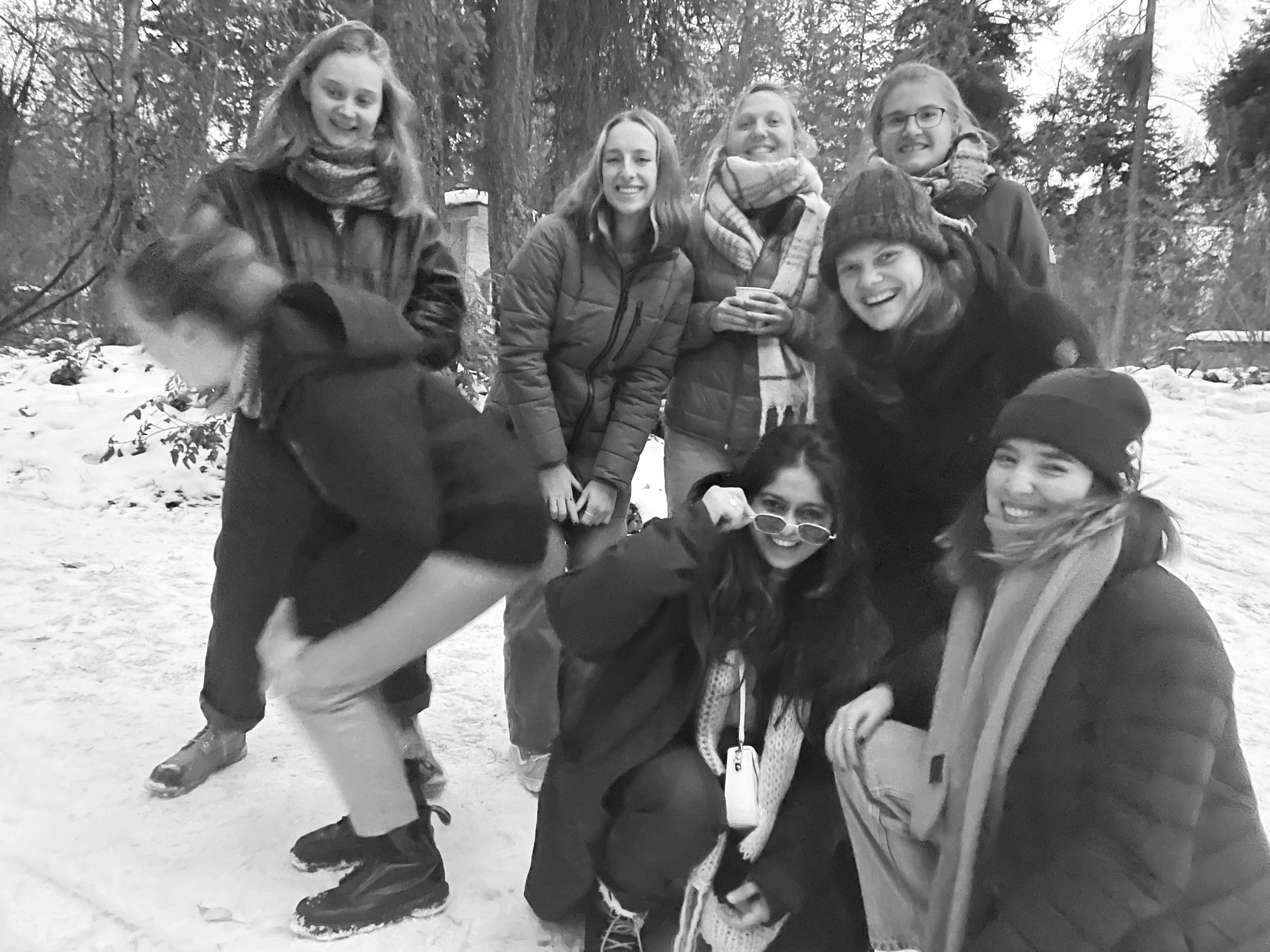
Through it all, the FEELed Lab has been sustained most importantly by the lands and waters of the syilx people. We are so grateful for the privilege of working and living here. We have enjoyed delicious food, warm friendships, dipping our tired feet in the creek, critical and awkward conversations (which are also important), learning, becoming overwhelmed and slowing down, listening to the birds, asking questions, watching the deer meander through the firepit circle, and more. We have deep gratitude to this Land and its original custodians for caring for each other, and hope to contribute to this care in all the ways we can.
In short, we don’t need to impose a mandate on ourselves to scale up or get bigger (even through we will inevitably change and grow/shrink organically). We need to tend to what we are already doing, and care for it. Care is time. We need to give it time. We need to keep recommitting to this work. Impact (whatever that means) will follow. Everyone is welcome on this journey.
 The FEELed lab