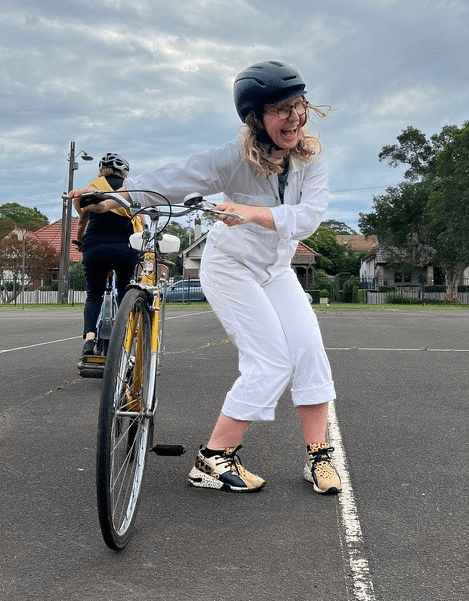
As we welcome new people to the FEELed Lab, we want to make space for longer introductions to project team members and research affiliates joining us this year. This profile is on Susanne Pratt, who joined the FEELed Lab as a visiting researcher in May 2026 and is currently an academic in Australia, at the University of Technology Sydney (UTS).
- Can you tell us about your work/research?
Current areas I am exploring in my transdisciplinary research, art and teaching include: participatory futuring, pollinators, creative intelligence, transdisciplinary curriculum, mutual learning, feminism, more-than-human relations, regenerative practices, and other collaborative entanglements.
Some recent questions I’ve been asking in my research/work:
- What if environmental intelligence were not simply the capacity of humans to sense and process large amounts of data on the environment with large amounts of technology, but referred to the intelligence of the environment?
- What does collaborating with more-than-human actors, such as a river or wombat, look and feel like in practice?
- What can we learn from bees, and other superorganisms?
- If we start from the position that we are the institutions we work in and contribute to, what are Universities for?
- What if transformative learning were not a hero’s journey but rather a feminist “carrier bag theory of fiction”?
- How might thinking with paradox and multiple temporalities enable shifting perspectives away from “either/or” locked-in positions and defensive postures, to visioning other possibilities together
- How do we compost or hospice ideas of the future that need to be let go of?
My university profile and links to my research can be found here here https://profiles.uts.edu.au/Susanne.Pratt
2. Why did you want to work with the FEELed Lab?
I’ve been following the FEELed Lab happenings from afar and was curious to connect further with the community during my sabbatical. I connected with the lab as I’ve known the director Astrida Nemanis since her time in Sydney, Australia. I appreciate the ways in which the lab emphasises valuing embodied and place-based ways of sensing-knowing-doing and encourages collaborative play across disciplines, including with creative arts. I’m also interested in social infrastructures that create spaces to imagine otherwise, so the timing was delightful to arrive for the Kelowna book launch of “How to Weather Together: Feminist Practice for Climate Change,” co-authored by Astrida with Jennifer Mae Hamilton, and illustrated by Tessa Zettel.
3. Why are expansive engagements with environmental issues important?
Within the context of Australia, Higher Education feels increasingly precarious and troubled. In this sector I work in, we are facing numerous reported governance issues and mass job losses, alongside a climate crisis, cost of living crisis, and crisis in confidence in what constitutes knowledge (with new pressures emerging due to GenAI, increasing polarisation, and a rising global tech Oligarchy, alongside other enshittification pressures). These are all entangled issues. How can we mobilise feminist care, pragmatic ethics and imaginative resistance to address the climate crisis, which is also to address rising authoritarianism and ongoing colonialism? What enabling conditions, places and people make change, care and creative play possible in these times? How do we learn together to enact this in ongoing practice with others.
 The FEELed lab