This FEELed Note was written by FEELed Lab research affiliates and climate solution scholars Jamie Stevens and Estraven Lupino-Smith whose project explores the potential of using arts‐led social infrastructures to address polarization for Anticolonial Climate Justice, with contributions from FEELed Lab research affiliates Lola Melchior and revisions from FEELed Lab research administrator, Julia Jung.
As outlined in our Connecting Otherwise FEELed Note, anti-colonial research requires relentless attention towards interconnection, contextual nuance, and relationality. Our project sought a creative, arts-lens for addressing polarization that could hold these elements.
Stories can hold all of this.
One of the leading scholars in humanities research, Anna Tsing (2015) speaks about stories as a way of engaging in multispecies world building, an important framing for climate justice. In her book, The mushroom at the end of the world, she states that stories help us notice the diversity of lifeways involved in collaborative survival. Her writing positions storytelling as a way that researchers can describe complex ecological and social relationships that couldn’t otherwise be understood through abstract theory. Storytelling differs from other practices because it isn’t grounded in material or physical practices, but rather, through relational and interpretive work. Stories can carry knowledge and conceptual framings about ecologies, colonial histories, and about multispecies interactions.
Storytelling as a creative arts-led method has broad appeal and can be adapted to many settings, including the rural communities we are focused on for this project. Podcasting is a method that uses storytelling while holding the complexities of an issue by being in conversation, and therefore, by being in relation. Unlike many conventional academic research outputs like journal articles or papers presented at symposiums or conferences, storytelling through podcasting has the capacity to present an idea over time and through an intimacy where listeners can build a kind of relationship with those telling the stories, where the motion, context, and lived experiences of hosts and guests can be communicated in a way that are not always possible through the written word.
Podcasting also fits as a feminist humanities research contribution. While institutions like the IPCC offer scientific information about climate and shifting conditions, climate justice remains an issue of power – who has it, who doesn’t and how this is unequally distributed. The podcast holds the possibility to dive into the power relations as they relate to climate narratives from Black, trans, ecofeminist perspectives in conversation with Indigenous, land-based action. Voices can be heard as they are, without being reinterpreted, softened or synthesized for academic writing expectations. This intersectional approach recognizes that different struggles for justice are entangled with climate justice, with the podcast presenting the complexities of these overlapping and compounding social forces without having to force a singular narrative.
Podcasts, as a form of digital storytelling, can act as a kind of oral history method for assembling the voices of the people we have been in conversation with, and to let their voices be (literally) heard through our research outputs. Podcasts have also been established in the literature as an arts-based method that can take research and make it accessible by connecting people through story, which can often be intimate and engaging (see Siobhan McHugh – The power of podcasting).
Podcasts have enjoyed rising popularity and can also be considered academic outputs themselves. Academic podcasts have begun to challenge the long-standing hegemony of written work in academia (Kinkaid et al. 2021; Turner et al. 2023). Political ecology scholar Burr (2022), for example, describes “academic podcasting as a feminist practice and a digital environmental public humanities method of collecting, collaging, and communicating stories” (70) in their thesis about living with wildfire in the Okanagan Valley. Community-engaged research and institutes have embraced podcasts as media for knowledge mobilization (i.e. Mobile ICER by UBCO’s Institute for Community Engaged Research or Below the Radar by SFU’s Vancity Office of Community Engagement). The publication A Guide to Academic Podcasting defines academic podcasting as “the communication of scholarly knowledge through the digital medium of podcasting….Podcasting can be a radical, open, and subversive way of creating publicly accessible and community engaged scholarship” (Copeland & McGregor 2021, as cited in Burr 2022). The medium of academic podcasting can be a practice (for host and guests) of unlearning exclusionary, elitist, opaque and extractionist practices in academia, and replacing them with accessible, collaborative, curious and critical inquiry.
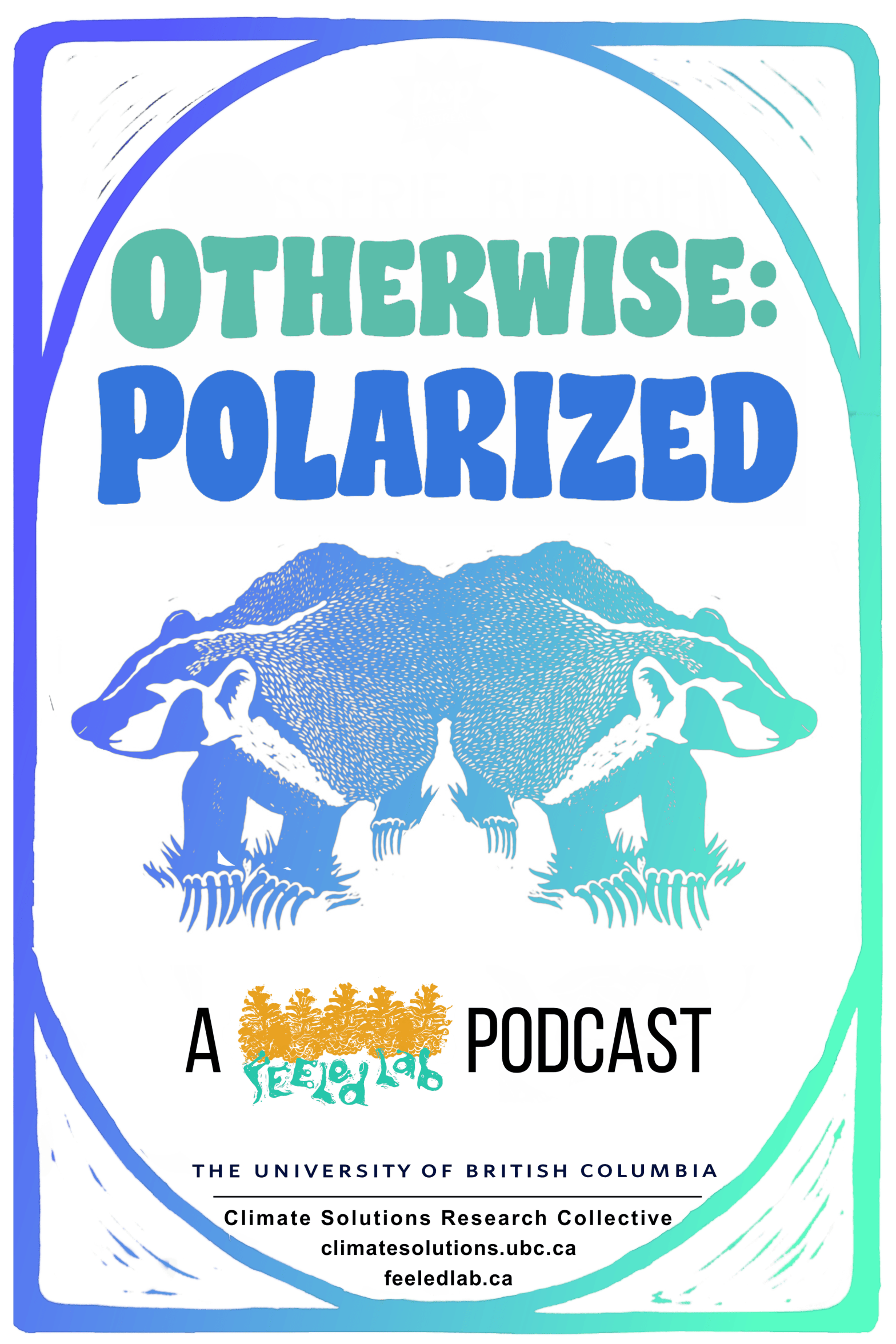
Another factor that contributed to podcasting being the creative method we chose for this research was that it mimicked our research process itself – as reading, writing, and thinking alongside each other required ongoing, iterative, dialogue. The name Otherwise Polarized for our podcast emerged from a discussion between Estraven and Jamie that went something like this,
Jamie: “arghhhhhh…. Why does everything say we’re so polarized?! We aren’t polarized, we are being polarized!”
Estraven: “definitely! Between algorithms and mainstream media there are so few options for folks to find their political home, and they get pushed into categories and identities that rely on a sort of weaponizing emotion.”
Jamie: “What if we name the podcast, “Elites use polarization as a tool to maintain the status quo of unjust systems while sacrificing justice and equality on the altar of social cohesion.”
Estraven: “hmmm.…ok… I’ve also been using the word Otherwise lately, to try to cue that we need to think differently…”
And so Otherwise Polarized was christened.
We came to realize that a podcast would be an interesting and dynamic way to bring storytelling and narrative into not only our research on this project, but that we could create the foundations for other FEELed Lab affiliates to pick up the podcast and continue it with their research. Therefore, our work this year established the foundational social infrastructure for a FEELed Lab podcast, as a way to make a critical contribution to climate justice storytelling (critical not just in ideological positioning, but also in that the format allows for resisting over-simplification).
Through our recorded conversations, we piloted three episodes of Otherwise Polarized as a demonstration of how researchers might use podcasts. This podcast can serve as an alternative to mainstream media that seems to consistently frame climate action as being about binary choices, pitting economic security against environmental protection, and, particular to our work, urban versus rural concerns. These false dichotomies do nothing to get us to engage with these complex issues, which need contextual solutions. Importantly, we also want this podcast to be a place to share stories that are grounded in place – particular territories, spaces, and places with their own intricacies that are not served by attempts at universal fixes. The stories that emerged in this season come from across so-called BC, from the territories of the Sinixt and W̱SÁNEĆ Nations.
In BC, these stories will need to take into account the realities of resource extraction economies, land ownership, shifting landscapes, and the push and pull of power dynamics at various levels of government. The narratives also question colonial governance models and attempt to give space for Indigenous and others marginalized by identity or experience to share their work that lies outside of formal political infrastructures, which often has greater impact in small and remote communities.
The podcast also holds the possibilities as a way for us, as settler scholars, to amplify and take seriously knowledge systems that have been excluded from mainstream discussion about climate mitigation. While some of this could come from us speaking about the work of these folks and their projects, the podcast also allows for airing the voices of the people themselves, as well as sharing soundscapes of water, wind, and land.
This podcast, however, will attempt to create a space for a kind of ‘imagining otherwise’ and invite academics, community members, organizers and visionaries to have these conversations together.
References:
Burr, J. (2022). Listening to fire naturecultures : a feminist academic podcast of fire knowledges in and around the Okanagan Valley (T). University of British Columbia. Retrieved from https://open.library.ubc.ca/collections/ubctheses/24/items/1.0416479
Copeland, Stacey and McGregor, Hannah. A Guide to Academic Podcasting (2021). Amplify Podcast Network. Accessed from: https://scholars.wlu.ca/books/2
Kinkaid, E., Emard, K., & Senanayake, N. (2021). The podcast-as-method?: Critical reflections on using podcasts to produce geographic knowledge. In Geographical fieldwork in the 21st century (pp. 78-91). Routledge.
McHugh. S. (2022). The power of podcasting: telling stories through sound. Columbia University Press.
Tsing, A. L. (2015). The mushroom at the end of the world: On the possibility of life in capitalist ruins (1st ed.). Princeton University Press. https://doi.org/10.1515/9781400873548
Turner, M. W., Schaefer, M. Y., Lowe, R. J., Ferguson, P., Lacy, B., & Derrah, R. (2023). A podcast format for expanding knowledge through engaging with expertise. Learning from students, educating teachers—Research and practice. JALT.

